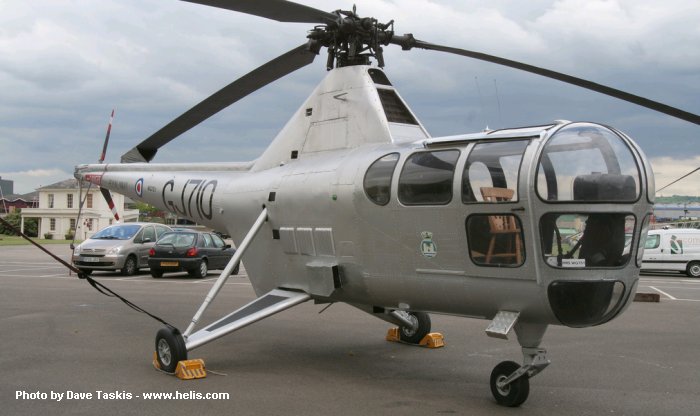
One of the six Sikorsky S-51s imported by Westland was chartered by the RN for trials on board HMS Vengeance in Jan 1949, while the Westland development programme continued. This was handed back in May 1949 and resulted in an order for 13 Dragonfly HR.1 (with wooden main rotors). First HR.1s came off the line in mid 1949 but were very sensitive to centre of gravity position. Between 13 Jan 1950 and Jun 1950, 705 Naval Air Squadron received 12 Dragonfly HR.1 with the UK Alvis Leonides 50 engine, replacing the Hoverfly. Much work was done in developing Search and Rescue (SAR), plane guard and Small Ships technique.
The Dragonfly replaced the Sea Otter in the SAR role and it also served as a plane guard, during fixed wing carrier operations (replacing a Destroyer and around 250 souls in the role) recovering the crew in case of deck accidents. 1st SAR Dragonfly unit embarked on HMS Indomitable on 12 Jan 1951. 2nd SAR unit on HMS Glory from Apr 1951 and rescued downed pilots during the Korean War.
These were followed into service by another 58 Dragonfly HR.3 (with metal main rotors). They served at numerous Station SAR Flights and aboard the UK carrier fleet. RNAS Lossiemouth (HMS Fulmar) was the 1st shore station to equip its SAR Flight with Dragonfly in Mar 1953. 15 RN shore stations and 9 RN carriers operated SAR Flights during the 1950s.
The Dragonfly HR.5 was an improved Royal Naval variant with a more powerful Alvis Leonides 5/231 engine, better communication equipment and instrumentation, introduced from 1953 (after lessons learned from the Dutch floods) by conversion of 25 existing HR.1 and HR.3 airframes, some converted at RNAY Donibristle. In some ways, the Dragonfly had a second wind in Fleet Air Arm service, as several were re-issued to Carrier SAR Flights (eg WP495) during the period that the Whirlwind HAS.7 was being re-worked to solve its initial engine problems.
There was a single Dragonfly planeguard:
705 NAS operated Dragonfly types until its last HR.5 was retired in Mar 1962. The last Dragonfly HR.1 were retired from BRNC Flight at Plymouth in Jun 1967. Total of 71 HR.1, HR.3 and HR.5 were built, the last being delivered in Sep 1953. Overall, the Dragonfly served the RN with reliability and distinction for 17 years.
The Dragonfly replaced the Sea Otter in the SAR role and it also served as a plane guard, during fixed wing carrier operations (replacing a Destroyer and around 250 souls in the role) recovering the crew in case of deck accidents. 1st SAR Dragonfly unit embarked on HMS Indomitable on 12 Jan 1951. 2nd SAR unit on HMS Glory from Apr 1951 and rescued downed pilots during the Korean War.
These were followed into service by another 58 Dragonfly HR.3 (with metal main rotors). They served at numerous Station SAR Flights and aboard the UK carrier fleet. RNAS Lossiemouth (HMS Fulmar) was the 1st shore station to equip its SAR Flight with Dragonfly in Mar 1953. 15 RN shore stations and 9 RN carriers operated SAR Flights during the 1950s.
The Dragonfly HR.5 was an improved Royal Naval variant with a more powerful Alvis Leonides 5/231 engine, better communication equipment and instrumentation, introduced from 1953 (after lessons learned from the Dutch floods) by conversion of 25 existing HR.1 and HR.3 airframes, some converted at RNAY Donibristle. In some ways, the Dragonfly had a second wind in Fleet Air Arm service, as several were re-issued to Carrier SAR Flights (eg WP495) during the period that the Whirlwind HAS.7 was being re-worked to solve its initial engine problems.
There was a single Dragonfly planeguard:
- on HMS Eagle (R05) between 1952 and 1959
- on HMS Albion (R07) & HMS Centaur (R06) from 1954 to 1960
- on HMS Bulwark (R08) 1955-1958
- on HMS Ark Royal (R09) from 1955 to 1960 and
- on HMS Hermes (R12) from 1960 to early 1962.
705 NAS operated Dragonfly types until its last HR.5 was retired in Mar 1962. The last Dragonfly HR.1 were retired from BRNC Flight at Plymouth in Jun 1967. Total of 71 HR.1, HR.3 and HR.5 were built, the last being delivered in Sep 1953. Overall, the Dragonfly served the RN with reliability and distinction for 17 years.
Plans for 18 further Dragonfly HR.3s (WP505-WP510 and WV933-WV944) were cancelled by the RN.
Units |
| Years | Units | Base |
|---|---|---|
| 1961/63 | 771 NAS | Portland Heliport |
| 1959 | 700 NAS | RNAS Yeovilton |
| 1958/60 | 727 NAS | Brawdy |
| 1957/62 | 705 NAS | RNAS Culdrose Lee-on-Solent |
| 1957/58 | 701 NAS | Lee-on-Solent |
| 1952/60 | 705 NAS | RNAS Culdrose Lee-on-Solent  Gilze-Rijen AB Gilze-Rijen ABHMS Siskin closed 1956 |
| 1952/59 | 728 NAS |  Nicosia (Lefkosia) Nicosia (Lefkosia) Hal Far closed 1987 Hal Far closed 1987 |
| 1952/54 | 744 NAS | Eglinton / Londonderry |
| 1950/53 | 705 NAS | Gilze-Rijen AB Portland Heliport HMS Siskin closed 1956 |
Platforms |
| Classes |
|---|
| CV Nairana class |
| CV Illustrious class |
| CV Audacious class |
| CV Centaur class |
| C Fiji class |
| AO Vidal class |
List of Aircraft |
| C/N | Mod | Built | ID In this Org | In other Org | |||
|---|---|---|---|---|---|---|---|
| wa/h/008 | hr.1 | 1949 | VX595 Fleetlands Museum from Feb 1990 |  VX595: HR.1 ff 18 Jun 1949, rotor development airframe at Yeov... VX595: HR.1 ff 18 Jun 1949, rotor development airframe at Yeov... Assignments at AFEE Beaulieu Jul and Nov 1949, and Jan ... conv HR.3 at Yeovil by 1953 conv HR.5 at RNAY Donibristle from Nov 1956 to Jun 195... VX595: to RAF Museum store at Henlow / 29, by Aug 1974, still ... | |||
| wa/h/009 | hr.1 | 1949 | VX596 705Sq Jun 1950, 705Sq/710-GJ by Jul 1951; Warrior Flt Nov 1951; Glory Flt Jan 1... | ||||
| wa/h/010 scrapped 1974 | hr.1 | 1949 | VX597 Built as HR.1 ff Oct 1949. 705Sq by Jan 1950, Indomitable SAR Flt by Jan 1952. F... | - VX597: Open storage at Blackbushe by ; sold to Yateley Commerc... | |||
| wa/h/013 | hr.1 | 1949 | VX598 del RN as Dragonfly HR.1 | ||||
| wa/h/018 w/o 1955 | hr.1 | 1950 | VZ960 to 705 NAS at Gosport. | VZ960: first flew at Yeovil. VZ960: HC.2 Del RAF Jan 1952 w/o 3 Nov 1955 after main rotor struck tail boom follow... | |||
| wa/h/021 | hr.1 | 1950 | VZ962 ff 18 May 1950 and del RNAS Gosport 13 Oct 1950. 705Sqn by Nov 1950. Believed Ca... | VZ962: To Cornwall Aero Park by Jul 1981 (marked /912-CU) and ... - VZ962: to British Rotorcraft Museum W-s-M by , still Dec 1993.... in pieces in Malta Aviation Museum by Sep 2020. | |||
| wa/h/022 w/o 1955 | hr.1 | 1950 | VZ963 ff 14 Jun 1950, dd 3 Oct 1950 Gosport to 705 Sq;RFA Fort Duquesne trials Jan 195... | ||||
| wa/h/023 w/o 1951 | hr.1 | 1950 | VZ964 ff Aug 1950. 705 Sq by Jan 1951; shipped to Far East aboard HMS Warrior, departe... | ||||
| wa/h/024 | hr.1 | 1950 | VZ965 ff Sep 1950, 705 Sq Nov 1950; Indomitable Flt 12 Jan 1951; shipped to Far East a... | ||||
| wa/h/033 w/o 1956 | hr.3 | 1952 | WG663 dd May 1952 as HR.3 to RNAS Gosport. To HMS Campania Jun 1952 for Operation Hurr... | ||||
| wa/h/034 | hr.3 | 1952 | WG664 hr.5 dd May 1952 as HR.3 to RNAS Gosport. To HMS Campania Jun 1952 for Operation Hurr... | ||||
| wa/h/035 w/o 1954 | hr.3 | 1952 | WG665 dd May 1952 as HR.3 to RNAS Gosport. To HMS Campania Jun 1952 for Operation Hurr... | ||||
| wa/h/037 scrapped 1976 | hr.3 | 1952 | WG667 901-CU ff 5 May 1952, del to Gosport 13 May 1952;
Sent to Far East aboard HMS Vengeance... | ||||
| wa/h/039 w/o 1960 | hr.3 | 1952 | WG669 HR.3 705 Sq/700-GJ by Aug 1952 to Holland 2 Feb 1953 for flood relief from Gilze... | ||||
| wa/h/040 | 1951 | WG670 dd to RN, soc to Blackbushe open storage. | - WG670: to Historic Aircraft Museum, Southend c . Damaged by fi... | ||||
| wa/h/041 | hr.3 | 1952 | WG671 705Sq/702-GJ Jul 1952 until c Aug 1953 | ||||
| wa/h/047 | hr.3 | 1952 | WG709 709-GJ 901 922-FD 977-C 982-FD to 705 NAS mid Oct 1952 | ||||
| wa/h/049 | hr.3 | 1950 | WG718 HR.3 Del RN | - WG718: Stored at Long Marston from early , until Jul 1995. Spares use by Yorkshire Helicopter Preservation Group J... | |||
| wa/h/050 | hr.3 | 1952 | WG719 ff 19 Sep 1952 as HR.3 Hal Far SAR Flt/901-HF by Jan 1953. | - G-BRMA: To Weston-super-Mare Apr 1976, for British Rotorcraft ... - WG719: pictured as WG719 in bare metal finish at Internationa... | |||
| wa/h/053 w/o 1961 | hr.3 | 1952 | WG722 ff 16 Oct 1952, dd 9 Dec 1952 Gosport. To Malta in HMS Indomitable 12 Jan 1953, ... | ||||
| wa/h/055 | hr.3 | 1952 | WG724 932-LM HR.3 built at Yeovil. ff Oct 1952, del RN 17 Nov 1952. | ||||
| wa/h/058 w/o 1953 | hr.3 | 1952 | WG748 ff 10 Nov 1952. dd as HR.3 to Gosport 1 Dec 1952, 705Sq, from West Malling to Ho... | ||||
| wa/h/059 | hr.3 | 1952 | WG749 ff Nov 1952 as HR, dd Dec 1952 to RNAS Gosport. Lossiemouth Stn Flt /903-LM Mar ... | ||||
| wa/h/061 | hr.3 | 1952 | WG751 ff Nov 1952; 705Sq/710-GJ by Mar 1953; Yeovilton Stn Flt/948-VL by Jan 1956;to R... | - WG751: Feb 1968 to Wisbech until c Jul 1972; Aug 1972 to scrap... Chatham Historic Dockyard; Moved between several scrap... Jun09 pictured at the Chatham Historic Dockyard ( The w... Sep16 still at Chatham Historic Dockyard Feb19 still at Chatham dockyard. Rotor has been removed... Oct19 still at Chatham dock yard. Rotor fitted. | |||
| wa/h/062 | hr.3 | 1952 | WG752 del RN Dec 1952; 728 Sq / 903 by May 1953; Ark Royal SAR Flt / 970-O Dec 1955; L... | - WG752: Sold to CCF at Alleyns School, Dulwich Jun 1970, still ... To IWM Duxford Dec 1985, until c Aug 1991. To Aviodome Museum, Schipol by Sep 1991 | |||
| wa/h/064 | hr.3 | 1952 | WG754 912-CU RN Dragonfly HR.3 d/d 15dec52;
conv to HR.5;
15jul97 pictured at Cornwall Aero ... | ||||
| wa/h/066 | hr.3 | 1952 | WH990 ff 26 Jan1953, dd RN 13 Feb 1953 | ||||
| wa/h/067 | hr.3 | 1952 | WH991 917-GN ff 4 Feb 1953 as HR.3, dd 24 Feb 1953 to RN at Gosport. To HMS Illustrious Ships... | ||||
| wa/h/068 w/o 1954 | hr.3 | 1953 | WH992 16 Feb 1953 first flew at Yeovil; Del Mar 1953 to Gosport | ||||
| wa/h/069 | hr.3 | 1953 | WN492 934-LM Feb 1953 flew at Yeovil on 25 Feb; del Gosport 19 Mar 1953; May 1953 to 705 Sq /... | ||||
| wa/h/070 | hr.3 | 1953 | WN493 del Mar 1953 to Gosport as HR.3; 705 Sq / 703-GJ by Sep 1954, 705 Sq / 534 by Ju... | ||||
| wa/h/071 | hr.3 | 1953 | WN494 Mar 1953 ff at Yeovil; Apr 1953 del RN at Gosport; May 1953 to Theseus SAR Flt; ... | ||||
| wa/h/072 w/o 1955 | hr.3 | 1953 | WN495 707-GJ 711-GJ to Gosport with 705 NAS | ||||
| wa/h/073 | hr.3 | 1953 | WN496 Apr 1953 to Ford SAR Flt / 981-FD until c Mar 1954; c Apr 1954 to Ford SAR Flt /... | ||||
| wa/h/074 | hr.3 | 1953 | WN497 Mar 1953 first flew Yeovil; Apr 1953 del Gosport; Jul 1953 to Eagle SAR Flt, cra... | ||||
| wa/h/076 | hr.3 | 1953 | WN499 HR.3 ff 21 Apr 1953, Illustrious SAR Flt May 1953 | Torbay Aircraft Museum WN499: Torbay Aircraft Museum Jun 1971, /-Y still there 1974, ... to Caernarfon Airworld by still Apr 1996, in poor cond... Yorkshire Helicopter Preservation Group Jun 2006. Still... | |||
| wa/h/077 | hr.3 | 1953 | WN500 Indomitable SAR Flt by Jul 1953; 705 Sq/704-GJ by Sep 1953; Lossiemouth Stn Flt/... | ||||
| wa/h/078 | hr.3 | 1953 | WP493 ff May 1953 as HR.3 and dd May 1953 to RNAS Gosport. Lossiemouth Stn Flt /903-LM... | ||||
| wa/h/079 scrapped 1966 | hr.3 | 1953 | WP494 11 May 1953 first flight at Yeovil; del Jun 1953 to Gosport. | ||||
| wa/h/080 | hr.3 | 1953 | WP495 ff 20 May 1953 as HR.3 at Yeovil; Del to Gosport | WP495: sold to Anglo Diesel Co Jun 1964 RAF Dragonfly HR.3 f/f 20may53; 14jul58 conv HR.5; feb... to King's School CCF, Wimbledon displayed at Warnham War Museum by Mar 1976 - G-AJOV: preserved at Royal Air Force Air Museum, Cosford to Morayvia Sci-Tech museum, Kinloss 27 Jul 2017, re-pa... still at Morayvia but painted as WP495 / 915-LM by date... | |||
| wa/h/082 | hr.3 | 1953 | WP497 To AHU Sembawang in HMS Perseus by Sep 1953; HMS Warrior SAR Flt by Aug 1954; HM... | ||||
| wa/h/083 w/o 1958 | hr.3 | 1953 | WP498 dd Jul 1953 to RNAS Gosport as HR.3. 4 month loan to RAN aboard HMAS Sydney as /... | ||||
| wa/h/086 w/o 1959 | hr.3 | 1953 | WP501 903-HF RN d/d Aug 1953; 728Sq / 903-HF Hal Far Station Flt, still Aug 1955 ; 728Sq / 95... | ||||
| wa/h/087 w/o 1958 | hr.3 | 1953 | WP502 902-BY 904-LM 983-B to Lossiemouth Stn Flt as /904-LM, subsequently to /902-LM. | ||||
| wa/h/088 | 1953 | WP503 built 1953, Eagle SAR Flt by Oct 1953; Lossiemouth Stn Flt; Lee-on-Solent; RAF N... | - WP503: to Humberside Aviation Museum in Jun 1976, wearing /901... to Bomber County Aviation Museum , until 1996. Sunk in lake at Capernwray Diving Centre, Lancs by Apr ... | ||||
| wa/h/089 scrapped 1974 | hr.3 | 1953 | WP504 del Sep 1953; Illustrious SAR Flt by Oct 1953, rotors struck tail while ship rol... | - WP504: To Anglo Diesel co.. To Blackbushe by road Apr 1965 for... | |||
No longer with this org.