I was teaching Rotary Wing Mechanics at
James Connally AFB, San Marcos, Texas,
in 1955. The Air Force announced the closing of the Base, with transfer of the
Rotary Wing mechanic School to Big Spring, Texas. Several of us decided we
would rather travel to "Foreign Shores", instead of going to Big Spring,
Texas.
And to address the issue, the Air Force had a request from Germany for helicopter mechanics. This fit the bill, nicely, and several of us applied for transfer to Germany. In fact most all of the Instructor group applied for transfer to Germany. So many, that the Air Force Command canceled all transfers. They needed the Instructors for the State Side School in Big Spring.
However, I was in a group that would have been discharged early, instead of transferring to Big Spring. Of course, I didn't know that, and had extended my enlistment in order to qualify for the tour in Germany. Ha, was I surprised.
With the cancellation of the German requirements, I was prime for assignment to a "needed" area - Eniwetok, Marshall Islands, where Atomic Bomb Tests were under way.
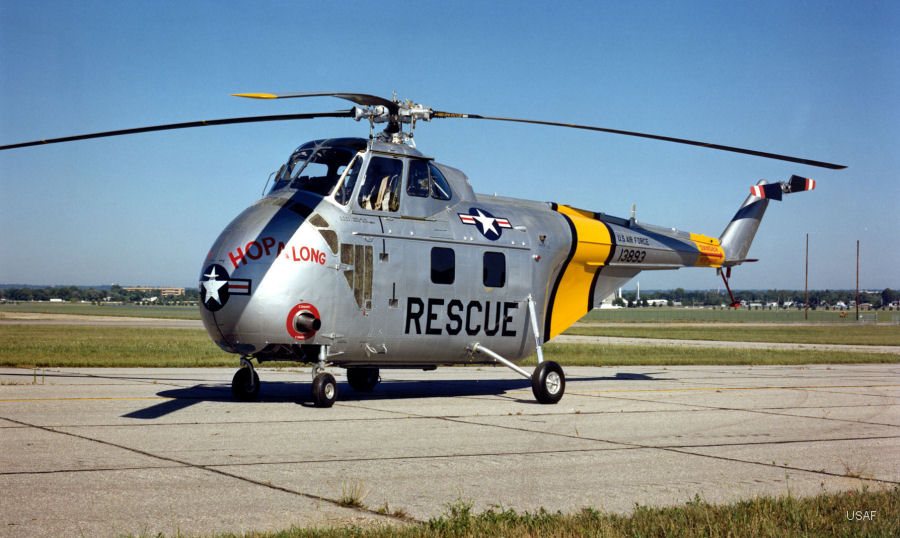
Our mission was to taxi the scientists to the test islands where they set up the particular test experiment. This was a relatively easy mission, with the furtherist Island about 35 miles away. Also, when on a mission, we were able to dine at the civilian Island - where there was fresh meat and fresh milk, and lots of fruit.
The atoll is beautiful, about 37 miles across, and the highest point is about 10 feet above sea level. The coconuts and the fish were not safe to eat, as they were contaminated from the exposure to the atomic and hydrogen bomb testing. The coconuts were mutated - shaped like bananas, but hard shelled like coconuts.
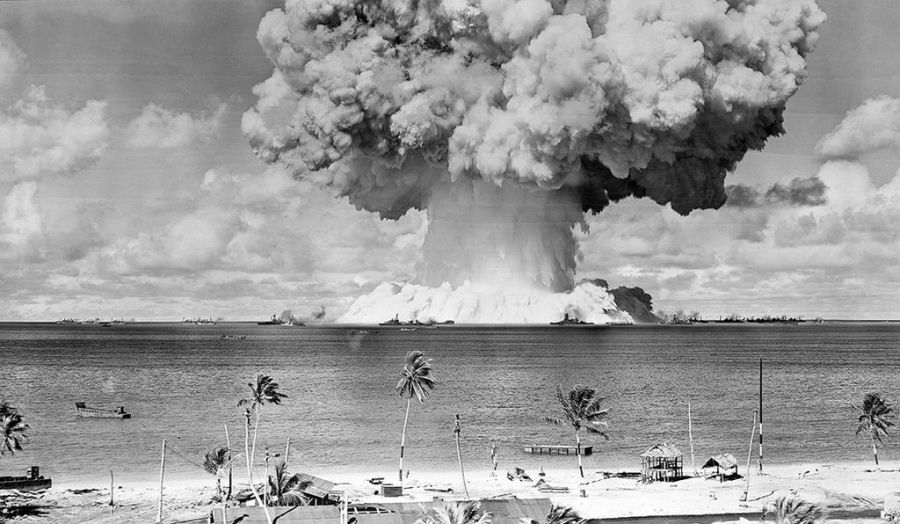
When a test was conducted, all personnel were accounted for and staged on the beach. We were instructed to sit on the sand, backs to the blast site, and heads on our knees - arms folded under our heads, on top of our knees. When the Bomb exploded, one could see the bones in one's arms from the electromagnetic shock - like a giant X-Ray ! We experienced about 10 tests. These tests were very small, about 10 kilotons. After the initial blast shock wave passed ( picking up gravel and sand from the beach), we were allowed to turn around and view the Atomic Cloud. (One had to have dark glasses to view the cloud). It was an awesome sight!
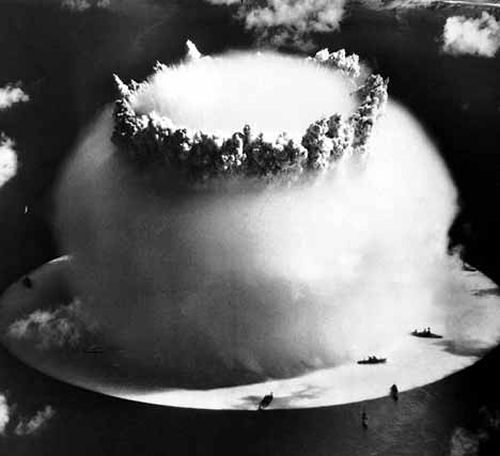
I had the opportunity to fly over the remains of Island "Mike", where the first Hydrogen Bomb was detonated in 1954. There is no Island Mike there anymore - just a hole in the coral reef, where Island Mike was. The hole is large enough to accommodate Eleven Pentagon Buildings !. It is over two miles in diameter ! The ocean color is similar to deep water - dark blue. It is difficult to comprehend that so much material was vaporized from the explosion. Military and Civilian personnel were taken off the atoll during this test, and remained at sea for several weeks until the radiation count was low enough for them to return.
On return from a mission, we turned in our daily film badge , so it could be read and entered into our exposure record. If one approached the exposure limit, then one was relieved of duty and sent off the island. I never knew anyone who was given alternate duty and sent to another location, due to excess radiation exposure.
Daily routine was to do periodic maintenence on the H-19's, and to assist Base Maintenence personnel in annual and major maintenence issues.
In Base Maintenence we had a very good - excellent - welder, who could repair intake manifolds on the H-19 ( which were prone to crack). The intake manifold is made of magnesium. He had successfully repaired several cracks, using inert gas welding. Once when he was off duty, another welder attempted to repair a crack, with disastrous results. One must be very careful when welding aluminum or magnesium as the critical temperatures are very close to the welding temperatures. This fellow exceeded the critical temperature, and all of the sudden we had a 6 inch hole, instead of a small crack. Wow, what a mess, requiring a new manifold.
The H-19's were scheduled for "remanufacture" in Japan. We dissembled the choppers, removing the rotor blades, tail cone, etc., and boxed up the entire aircraft in three plywood boxes. We carefully mounted the chopper into the giant boxes and loaded them on freighters for Japan. Several of them were lost along the way, with boxes mixed up, and some left on Docks throughout the Far East. We finally received the ships back at Eniwetok. I couldn't see they had accomplished anything, in that the re-manufactured machines looked just like the ones we hadn't sent. Ha.
When the Joint Task Force 7 project was over, we remained to give further taxi service to the scientists evaluating the past experiments. Now most service personnel were transferred back to the States, but the Helicopter Squadron became a Detachment from Far East Air Force. This presented little problem, except that we had to establish a supply of parts necessary for daily maintenance of the helicopters.
We set up a disposable parts listing and inventory so that we didn't have to visit base supply for a single bolt or cotter pin. I volunteered to set up this system, knowing about the different systems that required routine maintenence. This worked pretty well, but excluded me from further flying missions.
When my tour was due to be up - 12 months - my orders became lost in the red tape with information coming from the Far East Air Force. Seems they had lost all records of the Eniwetok Detachment 5. I was due to come home, and had no orders. Finally, after 12 months and two weeks, I got a set of orders to return to San Francisco. There I waited another two weeks for final orders relieving me of duty and Discharge on June 22, 1957.
It was an experience I would not have missed, but I have had concern about the radiation exposure. As of now there seems to be no problem for me or in my children. Only time will tell. I can only hope these tests were effective in determining that Atomic Warfare is an impossible method of confrontation. Since many nations have atomic weapons, none of us can afford to use them. Use would only destroy the world.
And to address the issue, the Air Force had a request from Germany for helicopter mechanics. This fit the bill, nicely, and several of us applied for transfer to Germany. In fact most all of the Instructor group applied for transfer to Germany. So many, that the Air Force Command canceled all transfers. They needed the Instructors for the State Side School in Big Spring.
However, I was in a group that would have been discharged early, instead of transferring to Big Spring. Of course, I didn't know that, and had extended my enlistment in order to qualify for the tour in Germany. Ha, was I surprised.
With the cancellation of the German requirements, I was prime for assignment to a "needed" area - Eniwetok, Marshall Islands, where Atomic Bomb Tests were under way.
I received orders for Eniwetok in May, 1956, with departure in June. The
assignment was to the Rotary Wing Maintenence Squadron on Eniwetok, to service
H-19D ( Sikorsky S-55 ) helicopters;
in support of the scientists that were conducting Atomic Bomb tests on the Eniwetok Atoll.
We were assigned as part of Joint Task Force 7, and had a fleet of about six (6) H-19D helicopters. Previously the squadron had H-19 A's, which were not suitable for the mission.
On arrival in Eniwetok, we were issued "film badges" to determine exposure to the potential radiation hazard from the Atomic tests. When conducting taxi services for the scientists, we were issued daily film badges to account for the radiation exposure on the test islands.
We were assigned as part of Joint Task Force 7, and had a fleet of about six (6) H-19D helicopters. Previously the squadron had H-19 A's, which were not suitable for the mission.
On arrival in Eniwetok, we were issued "film badges" to determine exposure to the potential radiation hazard from the Atomic tests. When conducting taxi services for the scientists, we were issued daily film badges to account for the radiation exposure on the test islands.
Our mission was to taxi the scientists to the test islands where they set up the particular test experiment. This was a relatively easy mission, with the furtherist Island about 35 miles away. Also, when on a mission, we were able to dine at the civilian Island - where there was fresh meat and fresh milk, and lots of fruit.
The atoll is beautiful, about 37 miles across, and the highest point is about 10 feet above sea level. The coconuts and the fish were not safe to eat, as they were contaminated from the exposure to the atomic and hydrogen bomb testing. The coconuts were mutated - shaped like bananas, but hard shelled like coconuts.
When a test was conducted, all personnel were accounted for and staged on the beach. We were instructed to sit on the sand, backs to the blast site, and heads on our knees - arms folded under our heads, on top of our knees. When the Bomb exploded, one could see the bones in one's arms from the electromagnetic shock - like a giant X-Ray ! We experienced about 10 tests. These tests were very small, about 10 kilotons. After the initial blast shock wave passed ( picking up gravel and sand from the beach), we were allowed to turn around and view the Atomic Cloud. (One had to have dark glasses to view the cloud). It was an awesome sight!
The cloud was mushroom shaped, with the top of the cloud, white. The shaft was
Crimson and Black. The cloud was growing upward at a very high rate - upwards
through 30,000 feet or more. Very Awe Inspiring to a young bunch of service
men.
I once tried to go to Bikini for a test being held there. I had been relieved of duty, awaiting orders to go home, but was not allowed to go. I did rise early on the morning of the test, and awaited the countdown over the Public address system. I looked into the dark night sky, in the direction of Bikini Island at the zero hour. Bikini is about 180 miles away from Eniwetok. When the Bomb went off, I could see flashes of light - like lightning in the sky, and several minutes later could hear rumbling like thunder - all from 180 miles away. WoW! That is like seeing flashes and sound of an atomic blast occurring in Norfolk, VA, from Washington, D.C. The power released is almost impossible to describe. I wish the leaders of all countries could experience this revelation of power, so they could better decide on NOT USING ATOMIC WEAPONS. If an Atomic War is Ever Started, that will be the end of Civilization as we know it to be. Controlled Atomic Warfare is not a viable choice. Seeing a test blast is a humbling experience.
I once tried to go to Bikini for a test being held there. I had been relieved of duty, awaiting orders to go home, but was not allowed to go. I did rise early on the morning of the test, and awaited the countdown over the Public address system. I looked into the dark night sky, in the direction of Bikini Island at the zero hour. Bikini is about 180 miles away from Eniwetok. When the Bomb went off, I could see flashes of light - like lightning in the sky, and several minutes later could hear rumbling like thunder - all from 180 miles away. WoW! That is like seeing flashes and sound of an atomic blast occurring in Norfolk, VA, from Washington, D.C. The power released is almost impossible to describe. I wish the leaders of all countries could experience this revelation of power, so they could better decide on NOT USING ATOMIC WEAPONS. If an Atomic War is Ever Started, that will be the end of Civilization as we know it to be. Controlled Atomic Warfare is not a viable choice. Seeing a test blast is a humbling experience.
I had the opportunity to fly over the remains of Island "Mike", where the first Hydrogen Bomb was detonated in 1954. There is no Island Mike there anymore - just a hole in the coral reef, where Island Mike was. The hole is large enough to accommodate Eleven Pentagon Buildings !. It is over two miles in diameter ! The ocean color is similar to deep water - dark blue. It is difficult to comprehend that so much material was vaporized from the explosion. Military and Civilian personnel were taken off the atoll during this test, and remained at sea for several weeks until the radiation count was low enough for them to return.
On return from a mission, we turned in our daily film badge , so it could be read and entered into our exposure record. If one approached the exposure limit, then one was relieved of duty and sent off the island. I never knew anyone who was given alternate duty and sent to another location, due to excess radiation exposure.
Daily routine was to do periodic maintenence on the H-19's, and to assist Base Maintenence personnel in annual and major maintenence issues.
In Base Maintenence we had a very good - excellent - welder, who could repair intake manifolds on the H-19 ( which were prone to crack). The intake manifold is made of magnesium. He had successfully repaired several cracks, using inert gas welding. Once when he was off duty, another welder attempted to repair a crack, with disastrous results. One must be very careful when welding aluminum or magnesium as the critical temperatures are very close to the welding temperatures. This fellow exceeded the critical temperature, and all of the sudden we had a 6 inch hole, instead of a small crack. Wow, what a mess, requiring a new manifold.
The H-19's were scheduled for "remanufacture" in Japan. We dissembled the choppers, removing the rotor blades, tail cone, etc., and boxed up the entire aircraft in three plywood boxes. We carefully mounted the chopper into the giant boxes and loaded them on freighters for Japan. Several of them were lost along the way, with boxes mixed up, and some left on Docks throughout the Far East. We finally received the ships back at Eniwetok. I couldn't see they had accomplished anything, in that the re-manufactured machines looked just like the ones we hadn't sent. Ha.
When the Joint Task Force 7 project was over, we remained to give further taxi service to the scientists evaluating the past experiments. Now most service personnel were transferred back to the States, but the Helicopter Squadron became a Detachment from Far East Air Force. This presented little problem, except that we had to establish a supply of parts necessary for daily maintenance of the helicopters.
We set up a disposable parts listing and inventory so that we didn't have to visit base supply for a single bolt or cotter pin. I volunteered to set up this system, knowing about the different systems that required routine maintenence. This worked pretty well, but excluded me from further flying missions.
When my tour was due to be up - 12 months - my orders became lost in the red tape with information coming from the Far East Air Force. Seems they had lost all records of the Eniwetok Detachment 5. I was due to come home, and had no orders. Finally, after 12 months and two weeks, I got a set of orders to return to San Francisco. There I waited another two weeks for final orders relieving me of duty and Discharge on June 22, 1957.
It was an experience I would not have missed, but I have had concern about the radiation exposure. As of now there seems to be no problem for me or in my children. Only time will tell. I can only hope these tests were effective in determining that Atomic Warfare is an impossible method of confrontation. Since many nations have atomic weapons, none of us can afford to use them. Use would only destroy the world.