Eurocopter Tiger ARH
in  Australian Army Aviation
Australian Army
Del'd 22 · Service : 2004 to present
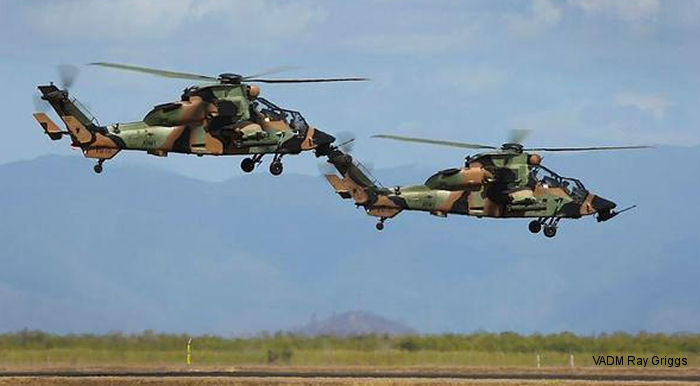
Use of the Tiger by Army Aviation has been a long time coming. It eventually won a competition on 21 Dec 2001, for an Armed Reconnaissance Helicopter (ARH) started in 1998, against the AH-64D, Agusta 129, the South African Rooivalk, Bell AH-1Z and the S-70 Battlehawk.
First 4 delivered directly by Eurocopter in Dec 2004 and the rest were assembled locally by Australian Aerospace at Brisbane, the last of the initial batch of 22 on 1 Dec 2011.
Replaced the Kiowa and Huey on operations.
First 4 delivered directly by Eurocopter in Dec 2004 and the rest were assembled locally by Australian Aerospace at Brisbane, the last of the initial batch of 22 on 1 Dec 2011.
Replaced the Kiowa and Huey on operations.
Final Operating Capability achieved by 1st Aviation Regiment in April 2016.
As of April 2019, the 22 helicopters have surpassed 30,000 flight hours.
In July 2019, Australian Department of Defence started the process of replacing the Tiger requesting proposals to Bell and Boeing selecting the AH-64E Apache in January 2021.
As of February 2026, the Australian Army's 22 Tiger Armed Reconnaissance Helicopters (ARH) are in a state of progressive withdrawal as the new AH-64E Apache Guardian fleet arrives. The fleet is scheduled for full retirement by 2028, though defense officials have indicated this timeline could be accelerated as more Apaches enter service.
The Australian Army’s experience with the ARH Tiger has been largely defined by persistent technical hurdles and high sustainment costs that ultimately led to its early retirement. While pilots have praised the aircraft’s exceptional agility and maneuverability, the fleet’s overall performance was marred by a seven-year delay in reaching Final Operational Capability (achieved only in 2016) and a litany of 76 capability deficiencies, 60 of which were deemed critical. Operational readiness remained a major pain point; at one stage in 2015, on average, only 3.5 aircraft from the 16-strong operational fleet were serviceable at any given time. Despite never seeing combat, the Tiger proved highly expensive to maintain, with flying hour costs exceeding $30,000—far beyond initial targets. These combined factors of low availability and a niche global supply chain prompted the decision to replace the fleet with the battle-proven Boeing AH-64E Apache.
Units
| 2008-2013 | 6th Aviation Regiment |
| 2008- | 1st Aviation Regiment |
| 2004- | 161 Reconnaissance Squadron |
News


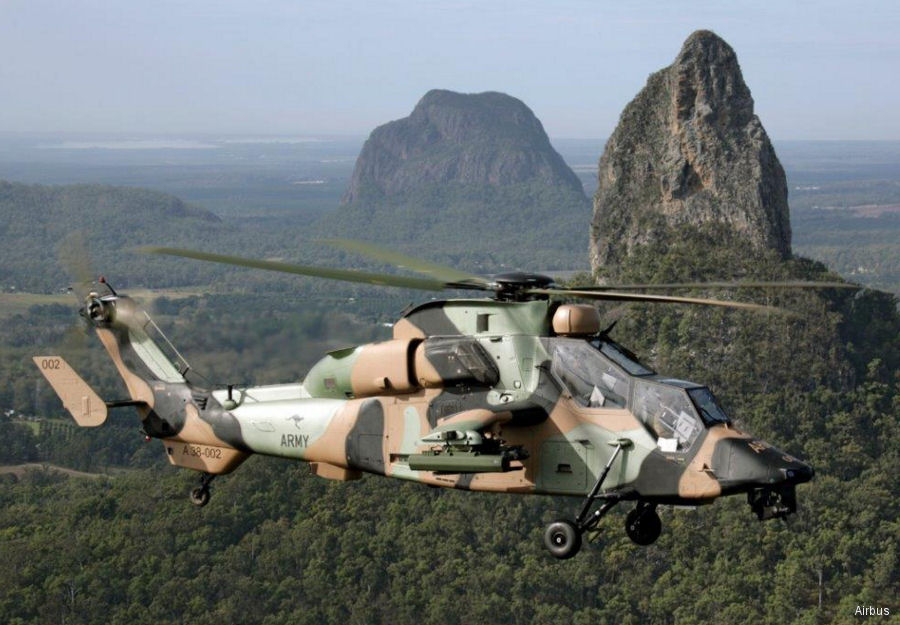
- Sep 13, 2018 · Airbus Instructor Sets World Record on NH90 and Tiger
- May 15, 2017 · Australian Tiger Achieves 2,000 Flight Hours
- Mar 21, 2016 · Australian Defence Force Exercise Jericho Dawn
- Apr 22, 2015 · Airbus Australia Joint Military/Civilian Support Centre
- Oct 20, 2014 · Australian Army Tiger Data Link Upgrade
- Oct 13, 2014 · BAE Systems APKWS Tested on Australian Tiger
- Sep 5, 2014 · Thales boosts Australian Tiger helicopter simulator
- Dec 1, 2011 · Australian Aerospace Delivers Final Tiger to Defence