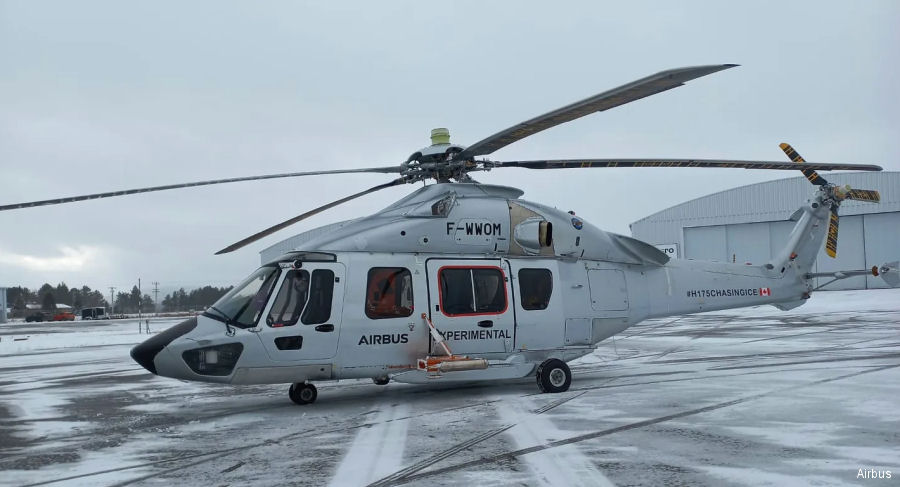

When the aircraft enters the clouds for example, ice can accumulate on various parts of the helicopter, which can be detrimental to its performance and the pilot’s ability to safely operate the aircraft.
Ice buildup on the windshield reduces visibility, while ice on the blades and airframe can weigh down and destabilise the aircraft.
FIPS (Full Icing Protection System)
n response to the challenges posed by in-flight icing, the European Union Aviation Safety Agency (EASA) requires that helicopters be equipped with certified equipment to safely operate in such conditions.
An example of a system that is employed by Airbus Helicopters, is FIPS (Full Icing Protection System).
The system is currently integrated on the NH90 and H225 and is being tested on the H175.
Developed by Airbus more than a decade ago, FIPS' key features include heated main and tail rotor blades, which essentially melt ice and snow as they hit the blades. It also includes a winter kit (already certified for limited icing conditions) for engine air intake, a horizontal stabiliser protection plate, an ice detector and a heated windscreen to help maintain visibility and navigate the helicopter safely in IMC (instrument meteorological conditions).
In addition to this, an electrical power distribution system, which is used to heat the main and the rear blades, is currently being enhanced for the H175 as it recently finalised its latest season of icing testing.
Marc Prunel, Experimental Test Pilot who recently embarked on the super-medium helicopter’s de-icing journey, explains the ease in using the system. “The pilot starts the system once the first visual detectors pick up icing. Once activated, the system works automatically, making the workload for the pilot negligible.”
Mainly located in the cargo bay, the system can also be removed in warmer weather to increase capacity for luggage transport. This can be particularly useful for operators who need to switch between cold and warm weather configurations. And when installed for icing conditions, the system’s compact size enables the continued use of the cargo bay - a plus for search and rescue operations for example.
FIPS Certification
Certification of FIPS on the H175 will enable pilots to fly up to 10,000 ft in icing conditions down to -40° celsius, with no time limitation - this will be a real game changer for operators in cold climates, such as Canada and Norway, tasked with more lengthy operations, like climate research, search and rescue, offshore transport and HEMS.
In order to meet the certification requirements, the aircraft must undergo a series of tests to demonstrate that it can withstand a wide range of atmospheric conditions. The first phase of testing involves placing the aircraft in a climate-controlled chamber to test the blades and heating cycles. “Once this stage is complete,” adds Marc Prunel, “the aircraft is tested in flight in dry conditions to ensure that the blades and heating cycles do not heat up. After this step, we go into the clouds and gradually work our way up.”
The first testing campaign, which took place in winter of 2021-2022, was performed in France (South Massif Central, Alps, and Brittany), and in Norway (Bronnoysund), with another campaign in Norway in 2023. While the flight test results provided useful insight, the H175 recently took off on another round of de-icing tests in order to test more extreme and varied meteorological conditions. The campaign, otherwise known as #H175chasingice, kicked off in southern Ontario, Canada in late 2023, with testing that continued in parallel in Norway on a second aircraft in 2024.
With more than 2.5 metres of ice accumulated over 200 flight hours, the H175 and the flight test team have had a rich and rewarding experience.