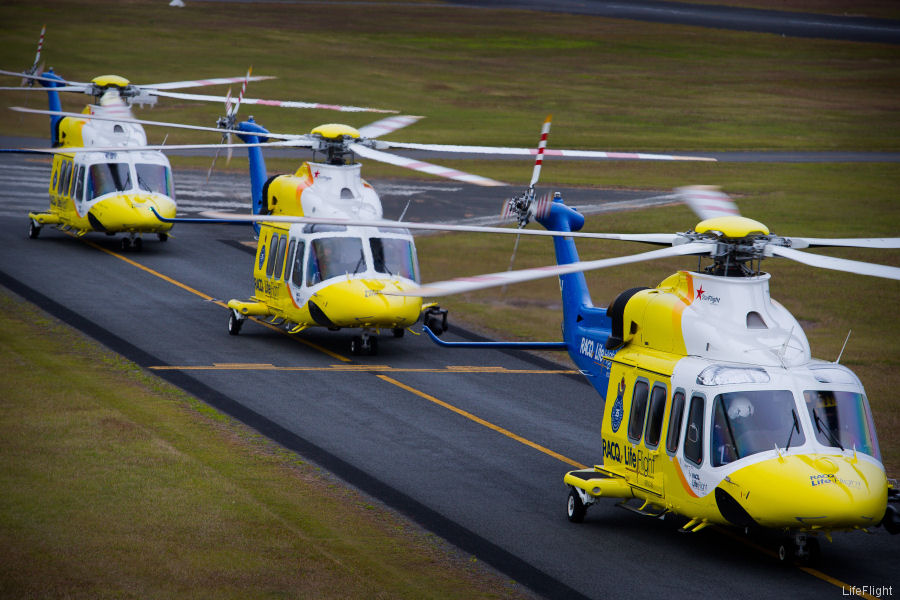
Established in 1981 as the Gold Coast Helicopter Rescue Service, the organisation was created to support communities across Queensland. In 1993 it became part of the Royal Automobile Club of Queensland (RACQ) and was renamed RACQ CareFlight. In July 2016 the service adopted the name LifeFlight. RACQ sponsorship concluded in 2024, with the Queensland Government assuming primary funding responsibility for the following decade.
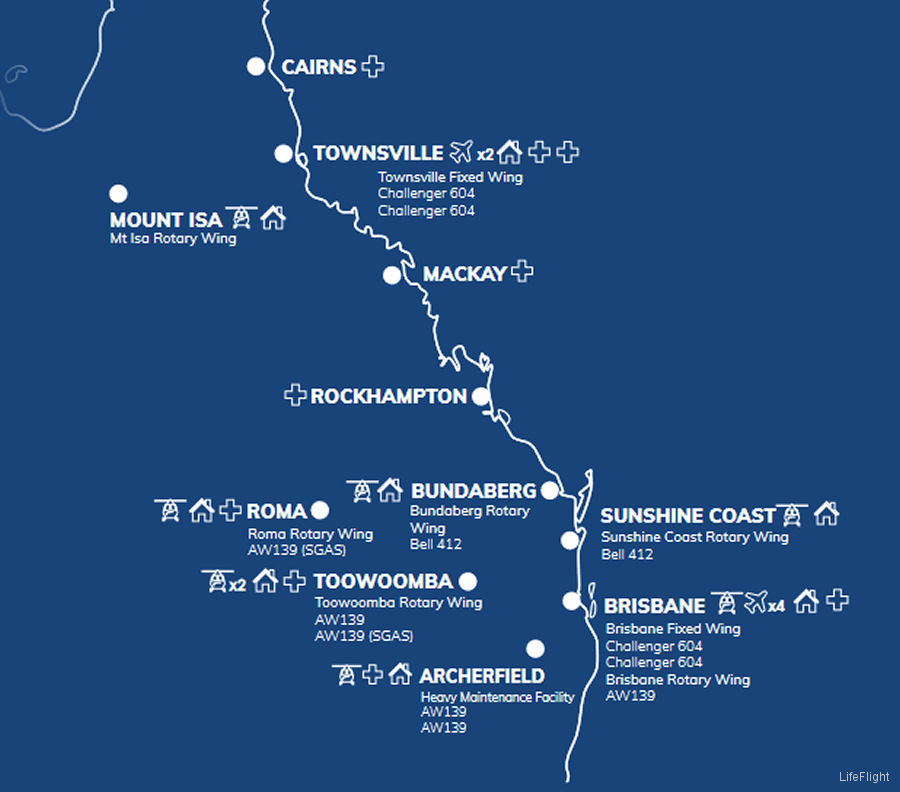
LifeFlight operates aeromedical rescue bases in Brisbane (joint helicopter and jet hub), Bundaberg, Sunshine Coast, Mount Isa (serving the vast North West region), Roma and Toowoomba, the latter being the busiest base in the network. The organisation also supports search and rescue (SAR) operations over more than 53 million km² of land and sea on behalf of the Australian Maritime Safety Authority.
As of 2020, the fleet included five AW139s, three Bell 412s, one BK117 and one AS350, completing more than 2,000 missions annually. Two AW139 aircraft, based in Toowoomba and Roma, operated under contract with a consortium of gas companies (Arrow Energy, Origin Energy, Queensland Gas Company and Santos) as part of the Surat Gas Aeromedical Service (SGAS).
By 2024, LifeFlight operated four air ambulance jets and nine helicopters on a 24/7 basis from multiple bases across Queensland and Singapore, directly serving an area of approximately 1.85 million km².
Following a landmark 10-year funding commitment from the Queensland Government in 2024, LifeFlight accelerated fleet modernisation, with seven additional AW139 helicopters entering service through 2025. A A$250 million partnership with Leonardo established LifeFlight as an authorized service and training centre, bringing advanced simulators and in-house maintenance capabilities to its Brisbane facility.
LifeFlight also conducts commercial activities, including its StarFlight joint venture with the Linfox Group.
LifeFlight operates aeromedical rescue bases in Brisbane (joint helicopter and jet hub), Bundaberg, Sunshine Coast, Mount Isa (serving the vast North West region), Roma and Toowoomba, the latter being the busiest base in the network. The organisation also supports search and rescue (SAR) operations over more than 53 million km² of land and sea on behalf of the Australian Maritime Safety Authority.
As of 2020, the fleet included five AW139s, three Bell 412s, one BK117 and one AS350, completing more than 2,000 missions annually. Two AW139 aircraft, based in Toowoomba and Roma, operated under contract with a consortium of gas companies (Arrow Energy, Origin Energy, Queensland Gas Company and Santos) as part of the Surat Gas Aeromedical Service (SGAS).
By 2024, LifeFlight operated four air ambulance jets and nine helicopters on a 24/7 basis from multiple bases across Queensland and Singapore, directly serving an area of approximately 1.85 million km².
Following a landmark 10-year funding commitment from the Queensland Government in 2024, LifeFlight accelerated fleet modernisation, with seven additional AW139 helicopters entering service through 2025. A A$250 million partnership with Leonardo established LifeFlight as an authorized service and training centre, bringing advanced simulators and in-house maintenance capabilities to its Brisbane facility.
LifeFlight also conducts commercial activities, including its StarFlight joint venture with the Linfox Group.
The Sunshine Coast helicopter rescue service was launched in December 1979 at Alexander Headlands Surf Club Site by the Premier of Queensland and the Gold Coast helicopter rescue service was launched in 1981. I can give anyone the exact dates if you wish as I have the log books. The Gold Coast Service was set up by the Sunshine Coast Service but we could not get a guarantor on the Gold Coast so the Sunshine Coast had to go guarantor and had the balance of power on the board for the first 5 years until the first helicopter had been paid off. Three of us were on the Gold Coast board and resigned together the day the guarantee was released and operated as seperate services until recently.nI was an Army pilot and left the Service in Dec 1979 to start the operation as i had a waterfront home at Maroochydore .Maj Jim Campbell DFC (Retd)

As of 2025, LifeFlight's fleet operates from 8 Queensland bases directly servicing an area of 1.85 million square kilometres. It also supports search and rescue efforts across 53 million square kilometres of land and sea for the Australian Maritime Safety Authority. LifeFlight recently welcomed three new AW139 helicopters to its fleet. By 2027 the 21-strong fleet will be among the largest in the country. In FY25 the organisation helped 8,497 people - with a patient helped every 62 minutes. More than 90,000 people have been airlifted since LifeFlight first took to the skies in in 1979.
 Models