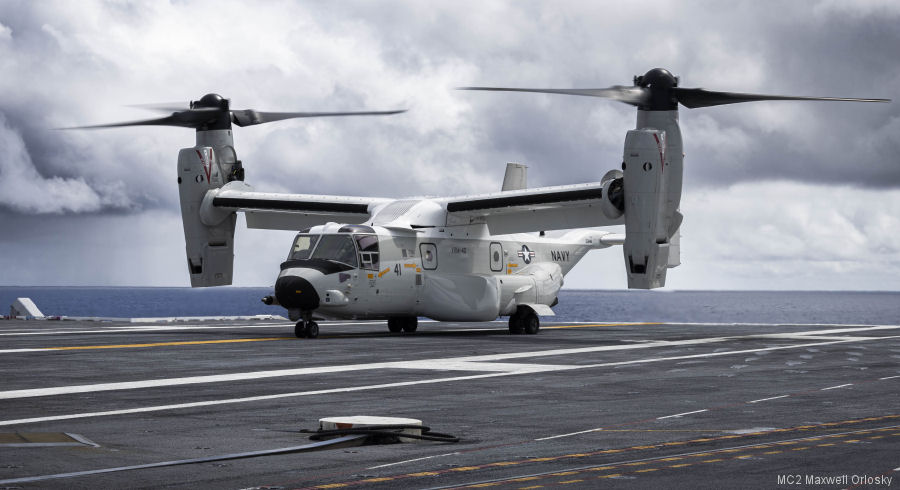
Defense.gov, March 25, 2025 - Bell Boeing Joint Program Office, Amarillo, Texas, is awarded a $590,000,000 fixed-price incentive (firm-target) undefinitized modification (P00080) to a previously awarded contract (N0001917C0015). This modification adds scope for the production and delivery of five CMV-22B aircraft for the Navy.
Work will be performed in Fort Worth, Texas (30.08%); Ridley Park, Pennsylvania (15.22%); Amarillo, Texas (12.73%);Red Oak, Texas (3.33%); East Aurora, New York (2.55%); Park City, Utah (2.20%); McKinney, Texas (1.33%); Endicott, New York (1.15%); various other locations within the continental U.S. (27.49%); and various other locations outside of the continental U.S. (3.92%), and is expected to be completed in January 2028.
Fiscal 2024 aircraft procurement (Navy) funds in the amount of $132,100,000 will be obligated at the time of award, none of which will expire at the end of the current fiscal year. This modification was not competed. Naval Air Systems Command, Patuxent River, Maryland, is the contracting activity.
CMV-22B Osprey interior
The CMV-22B Osprey, a variant of the Marines' MV-22B, replaces the C-2A Greyhound for the Carrier Onboard Delivery (COD) mission. As a tiltrotor V/STOL aircraft, it can take off and land like a helicopter while cruising as a turboprop.
This aircraft significantly enhances the Navy’s capabilities and operational flexibility compared to the C-2A. It can operate from shore bases, in expeditionary roles, or aboard ships, serving as a vital asset for time-sensitive combat logistics.
The Navy’s CMV-22B features an extended operational range, a beyond line-of-sight HF radio, improved fuel dump capability, a public address system for passengers, and enhanced lighting for cargo loading. It can transport up to 6,000 pounds of cargo or personnel over a range of 1,150 nautical miles.
The CMV-22B achieved Initial Operational Capability (IOC) in 2021. While the Program of Record includes 48 aircraft, the Navy currently plans to acquire 44.
In late 2023, a U.S. Air Force CV-22B Osprey crash off the coast of Japan prompted a widespread grounding of all V-22 variants across the U.S. Air Force, Navy, and Marine Corps. Following investigations and the implementation of new safety measures, the V-22 fleets have been cleared to resume flight operations although operational pauses have occured in 2024, due to further gearbox related issues.
Since becoming operational with the Marines in December 2005, the tri-service fleet has surpassed 750,000 flight hours.
Work will be performed in Fort Worth, Texas (30.08%); Ridley Park, Pennsylvania (15.22%); Amarillo, Texas (12.73%);Red Oak, Texas (3.33%); East Aurora, New York (2.55%); Park City, Utah (2.20%); McKinney, Texas (1.33%); Endicott, New York (1.15%); various other locations within the continental U.S. (27.49%); and various other locations outside of the continental U.S. (3.92%), and is expected to be completed in January 2028.
Fiscal 2024 aircraft procurement (Navy) funds in the amount of $132,100,000 will be obligated at the time of award, none of which will expire at the end of the current fiscal year. This modification was not competed. Naval Air Systems Command, Patuxent River, Maryland, is the contracting activity.
CMV-22B Osprey
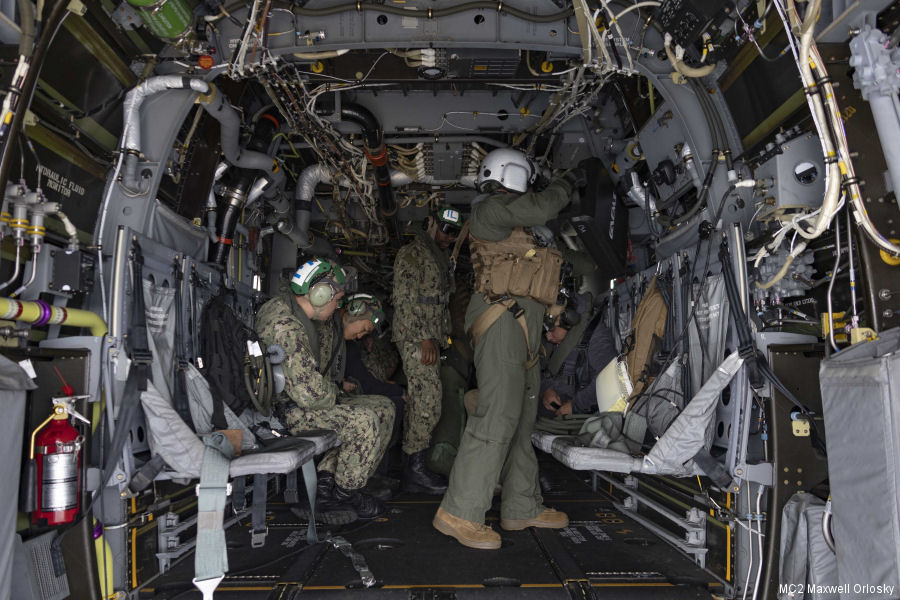
CMV-22B Osprey interior
The CMV-22B Osprey, a variant of the Marines' MV-22B, replaces the C-2A Greyhound for the Carrier Onboard Delivery (COD) mission. As a tiltrotor V/STOL aircraft, it can take off and land like a helicopter while cruising as a turboprop.
This aircraft significantly enhances the Navy’s capabilities and operational flexibility compared to the C-2A. It can operate from shore bases, in expeditionary roles, or aboard ships, serving as a vital asset for time-sensitive combat logistics.
The Navy’s CMV-22B features an extended operational range, a beyond line-of-sight HF radio, improved fuel dump capability, a public address system for passengers, and enhanced lighting for cargo loading. It can transport up to 6,000 pounds of cargo or personnel over a range of 1,150 nautical miles.
The CMV-22B achieved Initial Operational Capability (IOC) in 2021. While the Program of Record includes 48 aircraft, the Navy currently plans to acquire 44.
In late 2023, a U.S. Air Force CV-22B Osprey crash off the coast of Japan prompted a widespread grounding of all V-22 variants across the U.S. Air Force, Navy, and Marine Corps. Following investigations and the implementation of new safety measures, the V-22 fleets have been cleared to resume flight operations although operational pauses have occured in 2024, due to further gearbox related issues.
Since becoming operational with the Marines in December 2005, the tri-service fleet has surpassed 750,000 flight hours.
See also |
CMV-22B Osprey in


