AgustaWestland Lynx
AgustaWestland AW159 Wildcat HMA2
2012 · Twin-engine medium turbine helicopter
Factory at  Yeovil

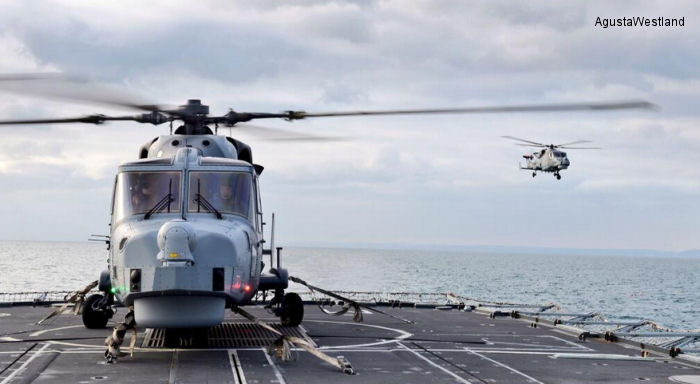
The AW159 Wildcat HMA2 (Helicopter Maritime Attack Mk2) is a modern multi-role naval helicopter developed by Leonardo (formerly AgustaWestland) as an advanced successor to the Westland Lynx. Built at Yeovil in the United Kingdom, the type entered operational service with the Royal Navy in 2015 following its first production flight in 2013.
The HMA2 features a strengthened airframe and is powered by two LHTEC CTS800-4N turboshaft engines, providing improved performance, endurance, and the ability to operate in demanding maritime and adverse weather environments. Its avionics suite includes the Seaspray 7000E active electronically scanned array (AESA) radar, offering 360-degree surveillance and advanced target tracking, complemented by an MX-15D electro-optical/infrared sensor for precision identification.
Designed for a wide spectrum of naval missions, the Wildcat HMA2 is equipped with a versatile weapons package. This includes Martlet lightweight multirole missiles for engaging fast, small targets, Sea Venom anti-ship missiles for larger surface threats, and Sting Ray torpedoes for anti-submarine warfare, along with a door-mounted heavy machine gun for force protection.
Typically deployed aboard frigates and destroyers, the Wildcat HMA2 supports anti-surface and anti-submarine warfare, maritime security, counter-piracy, search and rescue, and humanitarian assistance operations, making it a key component of the Royal Navy’s embarked aviation capability.
The HMA2 features a strengthened airframe and is powered by two LHTEC CTS800-4N turboshaft engines, providing improved performance, endurance, and the ability to operate in demanding maritime and adverse weather environments. Its avionics suite includes the Seaspray 7000E active electronically scanned array (AESA) radar, offering 360-degree surveillance and advanced target tracking, complemented by an MX-15D electro-optical/infrared sensor for precision identification.
Designed for a wide spectrum of naval missions, the Wildcat HMA2 is equipped with a versatile weapons package. This includes Martlet lightweight multirole missiles for engaging fast, small targets, Sea Venom anti-ship missiles for larger surface threats, and Sting Ray torpedoes for anti-submarine warfare, along with a door-mounted heavy machine gun for force protection.
Typically deployed aboard frigates and destroyers, the Wildcat HMA2 supports anti-surface and anti-submarine warfare, maritime security, counter-piracy, search and rescue, and humanitarian assistance operations, making it a key component of the Royal Navy’s embarked aviation capability.
Originally referenced as the Wildcat HMA.1 in official Royal Navy communications, from c May 2013, it began to be referred to as the Wildcat HMA.2 (the British Army version is known as the Wildcat AH.1).
Specifications
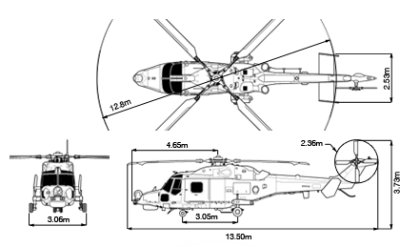
| Engine | 2 x Rolls-Royce CTS800-4N 1362 shp |
|---|---|
| Capacity | 2 |
| Length (m) | 15.22 |
| Height (m) | 3.73 |
| Blades | 4 |
| Rotor diam. (m) | 12.8 |
| Disc area (m2) | 128.71 |
| Weight (kgs) | Empty: 4700 Max: 6250 |
| Speed (km/h) | Max: 291 |
| Range (km) | 778 |
Operators
| 2001- | Leonardo UK Lynx |
| 2011- | Fleet Air Arm |