Sikorsky S-80 H-53E
Sikorsky CH-53E Super Stallion
1980 · Three-engine heavy turbine helicopter
Factory at  Stratford
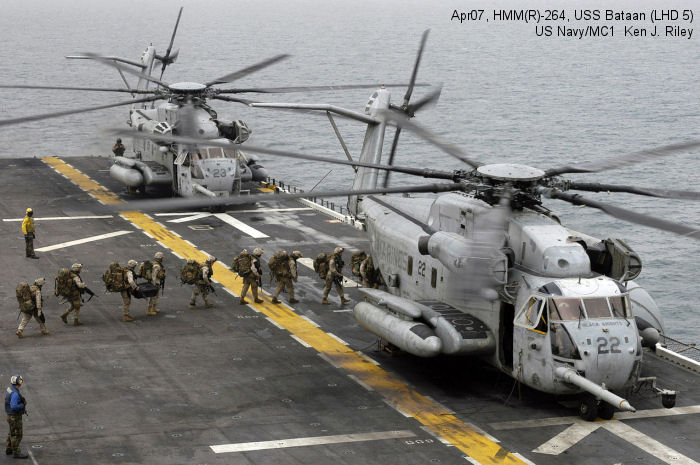
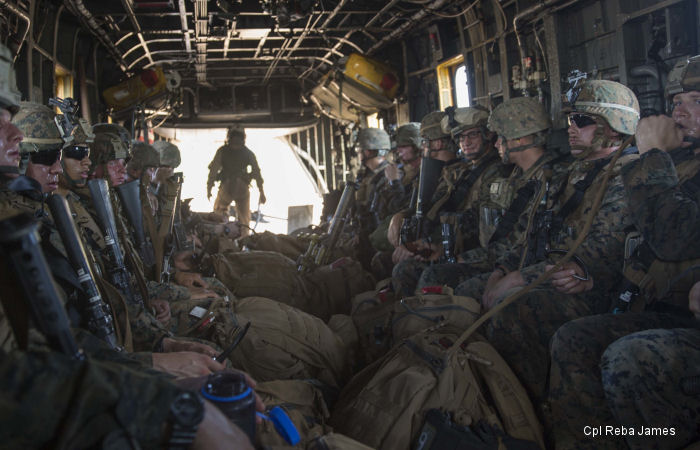
The CH-53E Super Stallion is a heavy-lift transport helicopter developed by Sikorsky for the United States Marine Corps. Introduced in the early 1980s, it remains the largest and heaviest helicopter in the U.S. military inventory. It was designed as an evolution of the CH-53D Sea Stallion, incorporating a more powerful propulsion system, an extended fuselage, and advanced avionics to meet the demanding requirements of amphibious assault and heavy logistical support. The Super Stallion quickly became the backbone of Marine Corps aviation for moving troops, vehicles, artillery, and supplies from ships to shore, and it has also played a critical role in humanitarian missions and disaster relief due to its unmatched lifting capacity.
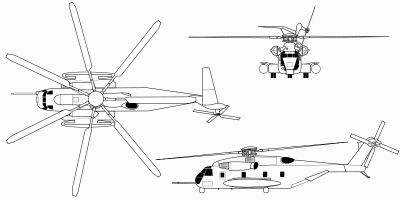
Technically, the CH-53E is powered by three General Electric T64-GE-416/416A turboshaft engines, each capable of producing over 4,300 shaft horsepower. This immense power drives a seven-bladed main rotor and a four-bladed tail rotor mounted on the starboard side in a canted configuration, which not only provides anti-torque but also additional lift. The helicopter can carry up to 30,000 pounds externally on a sling load, such as armored vehicles or artillery pieces, or transport up to 55 fully equipped troops inside its cargo hold. Its maximum takeoff weight exceeds 73,000 pounds, giving it the ability to perform missions that would otherwise require multiple aircraft. The Super Stallion is also equipped for aerial refueling, extending its range well beyond 600 nautical miles and allowing sustained long-distance operations.
Over its service life, the CH-53E has proven to be a versatile and rugged platform, though one that requires intensive maintenance due to its complexity and size. It has been heavily used in conflicts from the Gulf War to Iraq and Afghanistan, often operating in harsh environments where its heavy-lift capability was critical for resupplying forward bases and recovering damaged aircraft. Despite its effectiveness, the CH-53E fleet is aging, and the aircraft’s high maintenance demands have led the Marine Corps to pursue its replacement with the CH-53K King Stallion, which promises greater payload, advanced avionics, and reduced maintenance needs. Nevertheless, the Super Stallion remains an iconic symbol of Marine Corps aviation and a vital contributor to U.S. expeditionary operations for over four decades.
Technically, the CH-53E is powered by three General Electric T64-GE-416/416A turboshaft engines, each capable of producing over 4,300 shaft horsepower. This immense power drives a seven-bladed main rotor and a four-bladed tail rotor mounted on the starboard side in a canted configuration, which not only provides anti-torque but also additional lift. The helicopter can carry up to 30,000 pounds externally on a sling load, such as armored vehicles or artillery pieces, or transport up to 55 fully equipped troops inside its cargo hold. Its maximum takeoff weight exceeds 73,000 pounds, giving it the ability to perform missions that would otherwise require multiple aircraft. The Super Stallion is also equipped for aerial refueling, extending its range well beyond 600 nautical miles and allowing sustained long-distance operations.
Over its service life, the CH-53E has proven to be a versatile and rugged platform, though one that requires intensive maintenance due to its complexity and size. It has been heavily used in conflicts from the Gulf War to Iraq and Afghanistan, often operating in harsh environments where its heavy-lift capability was critical for resupplying forward bases and recovering damaged aircraft. Despite its effectiveness, the CH-53E fleet is aging, and the aircraft’s high maintenance demands have led the Marine Corps to pursue its replacement with the CH-53K King Stallion, which promises greater payload, advanced avionics, and reduced maintenance needs. Nevertheless, the Super Stallion remains an iconic symbol of Marine Corps aviation and a vital contributor to U.S. expeditionary operations for over four decades.
Specifications
| Engine | 3 x General Electric T64-GE-416 4380 shp |
|---|---|
| Capacity | 3 + 55 |
| Length (m) | 30.18 |
| Height (m) | 8.64 |
| Blades | 7 |
| Rotor diam. (m) | 24.08 |
| Disc area (m2) | 455.41 |
| Weight (kgs) | Empty: 15138 Max: 33339 |
| Speed (km/h) | Cruise: 278 Max: 315 |
| Rate/Climb (m/min) | 762 |
Operators
| 1979- | US Marine Corps S-80 H-53E |
| 1983-1995 | US Navy |