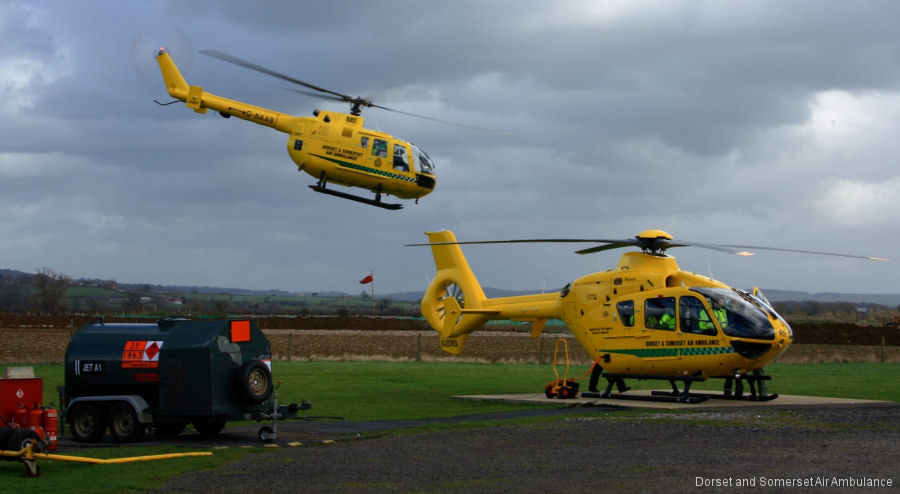

In the early years, DSAA only operated five days a week with a small team of pilots and paramedics. The aircraft was a Bolkow 105 helicopter with limited space and the equipment and skills of the team were similar to those you would find on a road ambulance
Fast forward to 2025 and over 29,000 missions later, the shift in care for the people of Dorset and Somerset has been remarkable. Our critical care team, consisting of consultant-grade doctors and specialist practitioners, now bring the hospital to the patient 19 hours a day, 365 days of the year. We also provide an enhanced care service across both counties with two outreach cars operating 12 hours a day and have a compassionate team of five patient and family liaison nurses.
Since 2017, we have operated a state-of-the-art AgustaWestland AW169 helicopter, which was the first AW169 to enter air ambulance operational service in the UK.
Charles Hacket, CEO of Dorset and Somerset Air Ambulance said: “Firstly, I would like to say thank you to everyone who supports us. Your donations have taken us from small beginnings to where we are today; providing pre-hospital critical care that no one imagined 25 years ago. This has only been possible because of consistent, regular commitment from our supporters. Whether they have joined our lottery, donated regularly, or supported us in other ways, they have directly contributed to saving lives. Without that support, we wouldn’t be where we are today and wouldn’t be able to do more tomorrow. For that, we are incredibly grateful.
"In 2016, we were tasked about 800 times, last year it was nearly 3,000. This continuous, step-by-step growth in care, in such a short period of time, has been nothing short of incredible. However, the cost of our operations has also steadily risen and now exceeds the generous income we receive. The charity has taken bold steps over the past decade, and that has been the right approach as it leads to saving life. But now we face the challenge of maintaining and being able to fund that boldness.
“We promise to continue engaging with our supporters to demonstrate the impact of their generosity and hope that they will remain with us for many years. At the same time, we need to expand our supporter base. So, if you know about DSAA, please tell others about our work and the difference that their support would make. Together, we can make sure that DSAA remains here, ready to respond, whenever and wherever we are needed.”
From G-NAAB to Peggy: 25 Years of Helicopter Innovation at DSAA
The Evolution of DSAA’s Helicopters
Unit Chief Pilot Mario Carretta takes us on a journey through the evolution of DSAA’s helicopters. From the early days of G-NAAB, the very first helicopter we operated, to state-of-the-art ‘Peggy’, which serves as a beacon of hope today.
In the 25 years of Dorset and Somerset Air Ambulance (DSAA) providing a Helicopter Emergency Medical Service (HEMS), the capability of our helicopter has improved significantly. Having latterly decided to invest in the AW169, we are now lucky to have a state-of-the-art machine, enhancing our ability to reach patients who need pre-hospital critical care.
The Early Years: The Bölkow 105
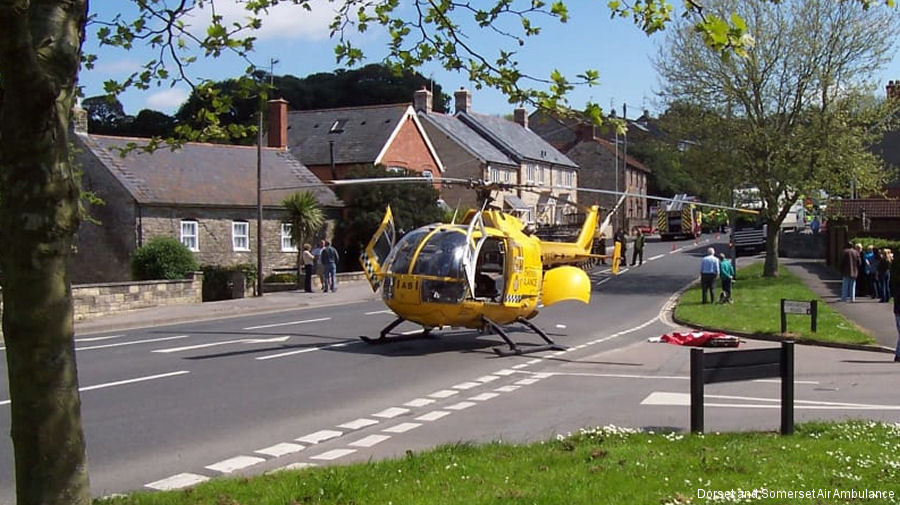
he charity’s first aircraft was a Bölkow 105 (BO105) helicopter provided by Bond Air Services and operated from a small, shared hangar at Henstridge Airfield. Its registration (G-NAAB) and its yellow paint scheme were linked to the fact that Centrica, the then owners of British Gas and the Automobile Association (AA), donated money to existing and emerging air ambulance organisations, including DSAA. Our current AW169 aircraft, G-DSAA (or ‘Peggy’ to many), retains the same AA yellow paint scheme applied to our original aircraft.
The BO105 was the first light twin-engine helicopter in the world, and the first rotorcraft that could perform aerobatic manoeuvres, due to its hinge-less rotor system; the latter being very impressive but not required for HEMS! Just under 12 metres in length and with a maximum takeoff weight of 2.5 tonnes, it was a fair bit smaller than the 15 metres and 4.8 tonnes of the AW169. Patient loading was through rear clamshell doors, which, due to slow start times, was often carried out with the rotors turning and perilously close to the moving tail rotor. Space in the cabin was very limited, with virtually no legroom for the paramedic-only crew.
Modern twin-engine helicopters are required, in the case of a single engine failure, to have enough performance available in the remaining engine to be able to land or fly away safely in certain situations. However, the single-engine performance in the BO105 was very limited. The aircraft was cleared for instrument flight in cloud, but it had a very basic auto-stabilisation system, without any form of automatic pilot holds, and this made flying in cloud very hard work for the pilot, so they avoided it if they could.
The EC135 Upgrade
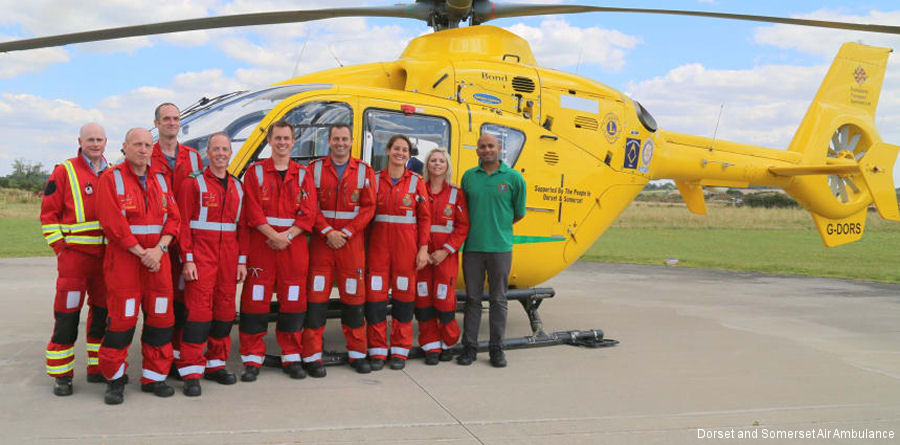
In 2007, DSAA replaced the BO105 with its successor from the Eurocopter factory, the EC135 (G-DORS), and moved to the Westlands site in Yeovil for a short period of time before moving back to a purpose-built hangar at Henstridge, our current home.
Slightly larger than the BO105, at 12.5 meters and 2.9 tonnes, it had enhanced safety through improved single-engine performance, a shrouded tail rotor, and a slightly larger cabin that allowed patients to be loaded through the side door. It also had a more modern cockpit, with some instruments being replaced by computer screens and an autopilot that could control three of the four axes. This made instrument flying a lot easier, even though the pilot still had to retain manual control of the rate of climb and descent.
The single pilot was assisted by a Technical Crew Member (TCM), which was one of the medical crew who had completed a short course on aviation-related matters such as navigation and weather. They would assist the pilot in flying to the scene but would then have to join the other clinician in the cabin when carrying a patient to hospital. This was achieved by simply turning the front left-hand seat around. Navigation was still carried out using paper maps and the old A-Z street maps (for those that remember them!), which took up a lot of cockpit space; it was surprising how many maps were required to cover Dorset and Somerset.
In April 2017, the charity’s aircraft operator changed to Specialist Aviation Services (SAS), who were to provide the new AgustaWestland (Leonardo) AW169 (G-DSAA). However, the aircraft was still awaiting full clearance for the SAS fitted HEMS equipment, and so SAS provided a McDonnell Douglas MD902 until June of that year. Very similar in capability and size to the EC135, but uniquely with its NOTAR (No Tail Rotor) technology, the MD902 was also to be the standby aircraft for a number of years before being replaced by AW169s from the SAS fleet.
The Transition to AW169
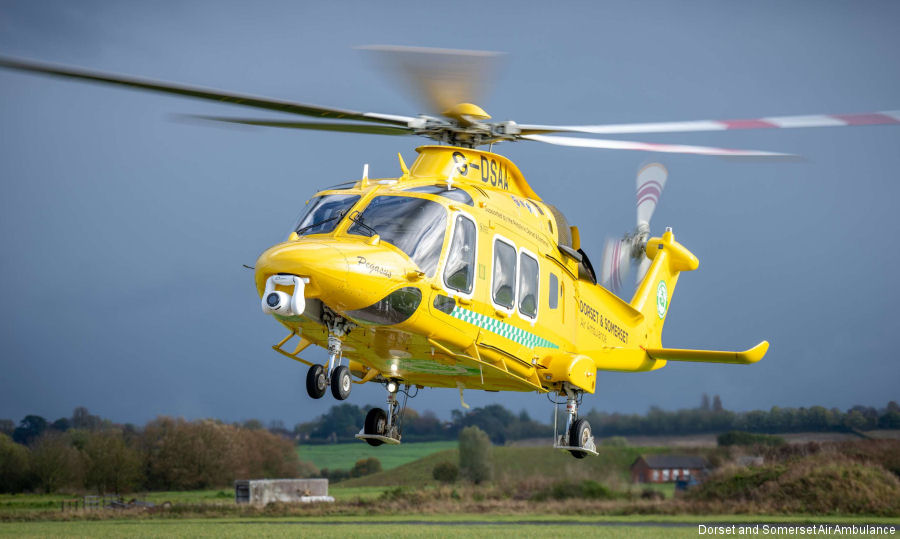
The AW169 was chosen with safety and patient benefit in mind. Its higher speed and increased range allow it to get to the extremities of the two counties within 25 minutes of launch from Henstridge, and it has the range to deliver critically ill patients to the major trauma centres in Bristol, Southampton, and Plymouth. The larger cabin also allowed our clinicians, for the first time, to have complete access to the patient in flight.
One of the other big advantages of the AW169 is that it allows for operations at night, and after extensive training in late summer, DSAA commenced night operations in November 2017. When flying during darkness, the crew are equipped with the latest technology night vision goggles, and we are aided by the nose-mounted Trakka searchlight. Getting to patients at night does require extra planning, and navigation is made much easier by an iPad-supported application called Aircraft Navigation and Command System (ACANS), which replaces all the paper maps and allows for communication with our tasking authority.
The cockpit is fully ‘glass’, which means that all the cockpit instruments and dials have been replaced by computer screens, which are reconfigurable and have redundancy in case of failures. The autopilot now controls all four axes, and so the aircraft can be commanded to carry out automatic instrument approaches, which will make things a lot easier for us when we have our GPS-based approach into Henstridge approved.
The AW169 is capable of twin pilot operations, but for over 20 years DSAA had been a single-pilot operation, with the pilots aided by a TCM. However, the decision was made in 2021 to introduce co-pilots on safety grounds, due in part to the increased level of missions at night and if we were to look at 24-hour operations in the future.
How to help Dorset and Somerset Air Ambulance
With each of DSAA’s missions costing approximately £3,500, your support is vital. With your help, we can continue saving lives for another 25 years. Please celebrate this milestone with us today by giving a one-off or monthly donation: www.dsairambulance.org.uk/25 or by calling: 01823 669604.