
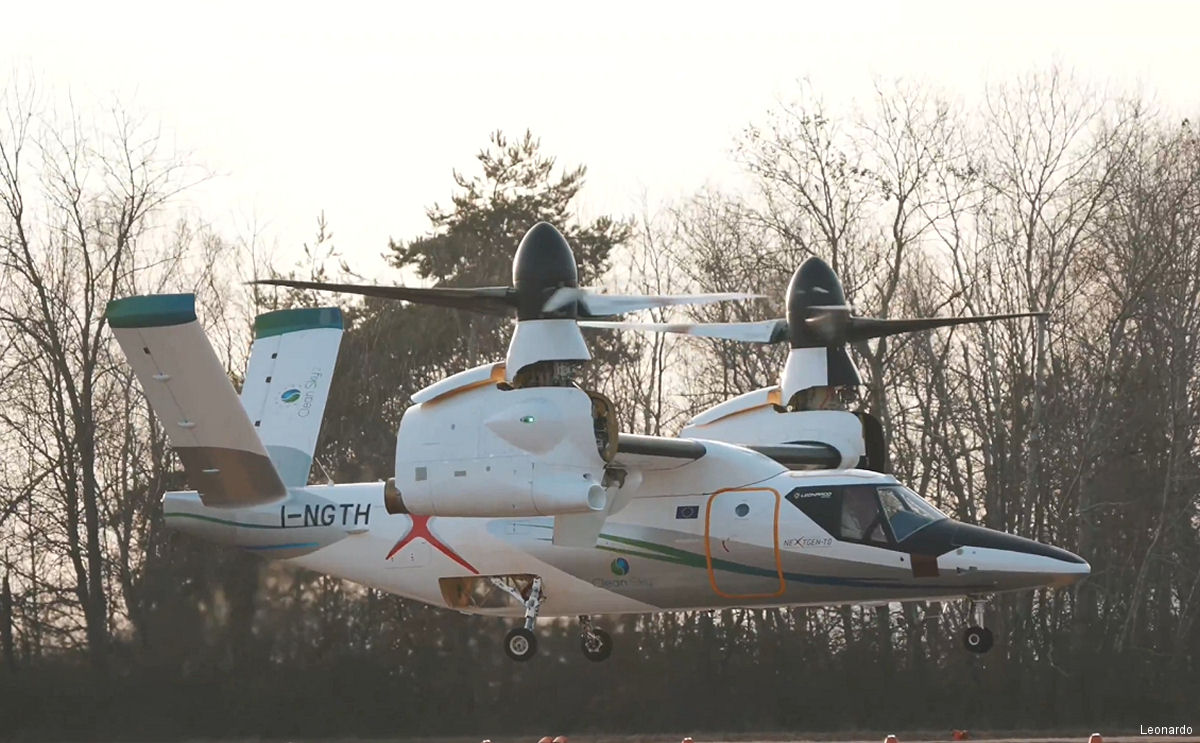
This achievement marks the official start of the flight test campaign for one of the most advanced civil aviation technology programmes currently underway in Europe, representing a significant step forward in the evolution of sustainable vertical lift solutions.
The NGCTR programme is designed to revolutionise civil vertical flight by combining the operational flexibility of helicopters with the speed and range of fixed-wing aircraft. The tiltrotor demonstrator is expected to deliver a cruise speed of approximately 280 knots and a range of around 1,000 nautical miles, enabling new operational scenarios across passenger mobility, cargo transport, and Search and Rescue (SAR) missions.
By offering faster response times and the ability to cover much larger areas, the NGCTR concept aims to significantly enhance mission effectiveness while reducing environmental impact through improved aerodynamic efficiency and advanced propulsion technologies.
The NGCTR-TD has been developed under the Clean Sky 2 programme, a flagship initiative of the European Union’s Horizon 2020 framework. The programme focuses on the research, development, and validation of breakthrough aeronautical technologies that reduce emissions, improve sustainability, and strengthen the European aerospace industrial supply chain.
With the first flight now completed, the NGCTR-TD enters a critical phase of flight testing that will further validate its performance and maturity, reinforcing Europe’s leadership in next-generation civil aviation technologies.
Gian Piero Cutillo, Managing Director of Leonardo Helicopters, stated: “Building on our established expertise in the tiltrotor domain, bringing this Technology Demonstrator to the air for the first time sets a major milestone on our path to provide a key contribution towards an even more advanced, effective and sustainable use of rotorcraft technologies in Europe. Vertical lift continues to provide invaluable advantages to operators and communities for multiple tasks globally, therefore we’re committed to developing and providing solutions that allow to uniquely combine the best of both worlds – rotary and fix wing architectures – allowing to access all-new capabilities.”
Axel Krein, Clean Aviation JU’s executive director, stated: “The NGCTR shows how Europe can turn ambition and vision into impact: the programme brought together more than 85 organizations from 15 countries with a common goal: to develop faster and more sustainable rotorcraft based on tilt-rotor architecture. With €116 million in EU funding across over 30 grant agreements, final outcomes go far beyond the project itself: more than 20 patents originated in the NGCTR, and the programme has helped drive skills development, industrial capabilities and new European supply chains. This makes the NGCTR–TD launched under Clean Aviation’s predecessor Clean Sky 2 – a key contributor to strengthening Europe’s strategic leadership in sustainable air transport.”
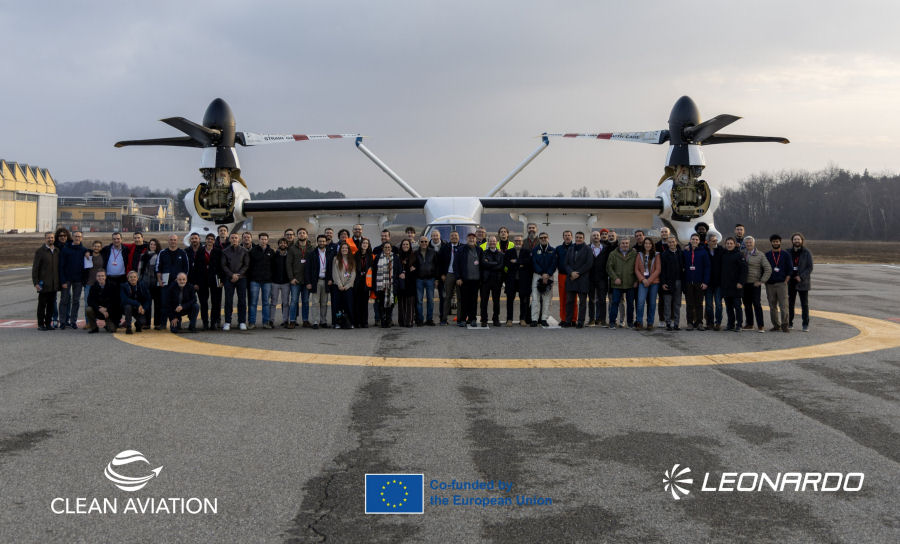
NGCTR-TD
The Next Generation Civil Tiltrotor (NGCTR) programme aims to revolutionise civil vertical lift by combining helicopter versatility with fixed-wing aircraft performance. With a cruise speed of 280 knots and a range of approximately 1,000 nautical miles, the tiltrotor opens new scenarios for mobility, freight transport and Search & Rescue missions, enabling faster coverage of larger areas with a significantly reduced environmental footprint.
The NGCTR-TD has been developed within Clean Sky 2, a core initiative of the European Horizon 2020 programme and an EU-funded Initiative for the development and validation of aeronautical technologies that will improve environmental impact and enhance the European aerospace supply chain. The NGCTR-TD brings together industry, research centres and academia to address the environmental and societal challenges of aviation, reducing emissions and noise while strengthening Europe’s global competitiveness.
Launched in 2015, the programme involves multiple organisations from several European countries, building an unprecedented level of know-how within the EU. Following the successful completion of ground runs in July 2024, the first flight represents a fundamental step toward validating the five new technologies and performance improvements in terms of CO₂, NOx and noise reduction, as well as lower cost of ownership.
The NGCTR-TD’s key enabling technologies include advanced wing architecture, innovative tail layout, non-tilting engine installation with high-efficiency nacelle architecture and split-gearbox drivetrain, an advanced, modular, distributed and scalable Flight Control System (FCS). The innovative solutions developed and integrated into the NGCTR-TD contribute to reduce drag, optimise engine installation, reduce on-ground emission effects and noise, enhance control and performance.
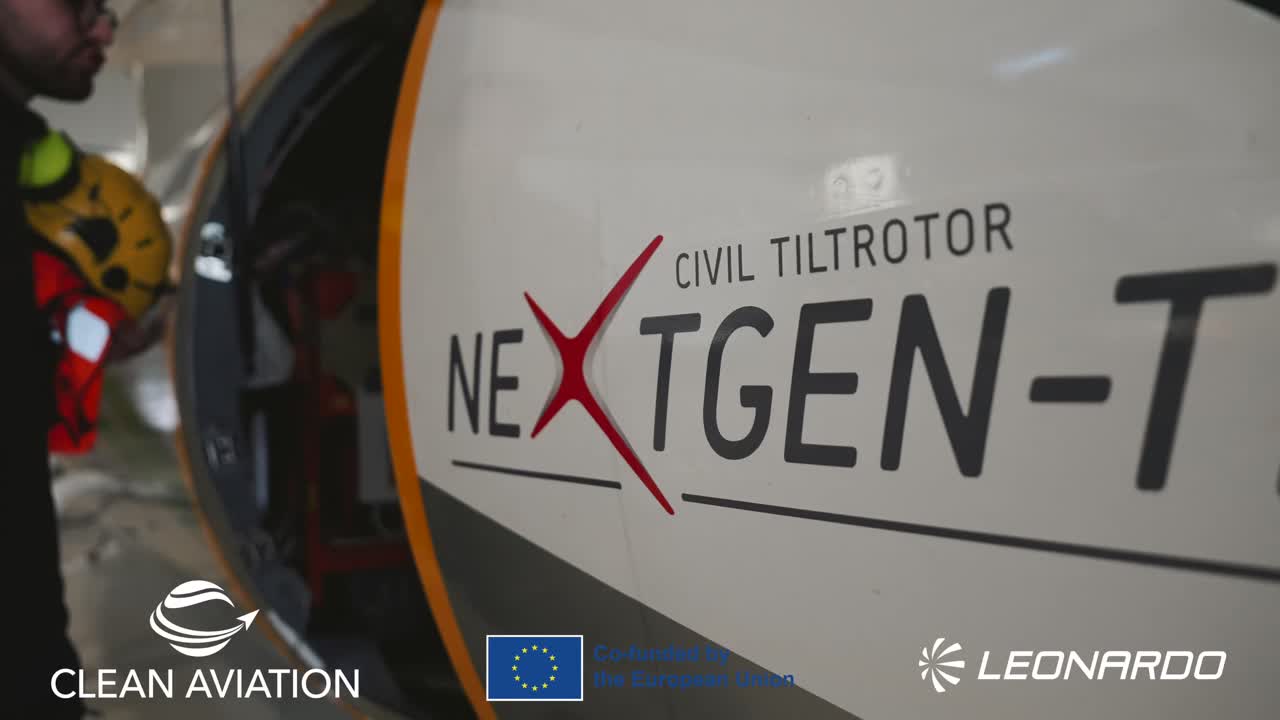

NGCTR I-NGTH ( Leonardo Italy )
 Vergiate
 Comments | Join community |
| What is the difference between this one and the 609 except for the V-tail? Is it bigger? |
| this is the Tech Demonstrator, mainly for the V tail and the Split Transmissions (like the V-280/MV-75). The TD fuselage is a modified AW609 item, the production NGCTR will have a 20-25 seat cabin IIRC so appreciably bigger. |
| Key Differences & Goals: Size & Capacity: NGCTR-TD is a demonstrator for a bigger aircraft, targeting 15-25 passengers, significantly more than the 9-seat AW609. Engine Design: NGCTR-TD keeps engines fixed and only tilts the propellers via a split-gearbox, unlike the AW609 where nacelles (engine + rotor) tilt together, simplifying mechanics and reducing stress. Technology Focus: It tests innovations like V-tails, advanced fly-by-wire, and improved aerodynamics for lower emissions and noise, acting as a bridge to future certified aircraft. Weight Class: The NGCTR project aims for an 11-tonne (approx. 24,000 lbs) max takeoff weight, compared to the AW609's 8 tonnes (approx. 18,000 lbs). In essence: The NGCTR-TD proves concepts for a larger, more efficient civil tiltrotor, building on the AW609's foundation but aiming for a higher capacity and advanced capabilities, not just being a slightly heavier version. (AI generated) |
| Seeing the next-gen civil tiltrotor flying is exciting! |
| Will this thing EVER enter service? |
See also |
Leonardo NGCTR
Clean Sky European Commission
Horizon 2020 European Commission