
The Coast Guard recently completed contract actions aimed at accelerating delivery of new MH-60 medium-range recovery helicopters and HC-130J long-range surveillance aircraft and expanding mission capabilities of the expanded aviation fleet.
On Sept. 8, the Coast Guard placed a $14.3 million order for delivery of 13 General Electric T700 engines for its MH-60 helicopter fleet. On Sept. 18, the Service contracted with L3 Harris Technologies Inc. for delivery of three AN/APY-11 multi-mode radar systems, valued at $13.9 million, to be installed on future HC-130Js during the Minotaur missionization process.
Both orders were made possible due to investments in the Coast Guard fleet made by the One Big Beautiful Bill Act (OBBBA).
The T700 engines are among the long lead-time components needed to grow the Coast Guard’s MH-60 fleet and expedite transition of several air stations from the MH-65E to the MH-60.
The MH-60’s range, speed, payload and avionics and sensors suite make it a capable platform for all 11 Coast Guard missions. The aircraft’s ability to locate, identify and track surface targets day or night makes it a valuable search and rescue and law enforcement asset. Transition of air stations is necessary to sustain rotary wing capability as the MH-65E continues to face supportability issues driven by a diminishing supply base for an out-of-production aircraft.
The AN/APY-11 radar system was chosen as the optimal multi-mode radar to enhance operational effectiveness as part of the Minotaur Mission System Suite. The Minotaur Mission System enables the collection and correlation of sensor and track data, which is used to conduct drug and alien interdictions, search and rescue, and other statutory missions.
The Coast Guard’s long-range surveillance fleet is a proven asset vital to control, secure and defend the U.S. border and maritime approaches, facilitate commerce vital to economic prosperity, and respond to crises and contingencies. The Coast Guard HC-130J fleet is the Department of Homeland Security’s airlift asset and can provide critical support to DHS partners in response to national events as well as logistical support during routine operations.
The OBBBA includes more than $3.3 billion to expand the Coast Guard’s HC-130J and MH-60 fleets. Nearly $2.3 billion is for the production and fielding of new MH-60 aircraft and delivery of multiple simulators. Approximately $1.1 billion is for production and missionization of six additional HC-130J aircraft, along with associated spare parts and the service's first HC-130J simulator.
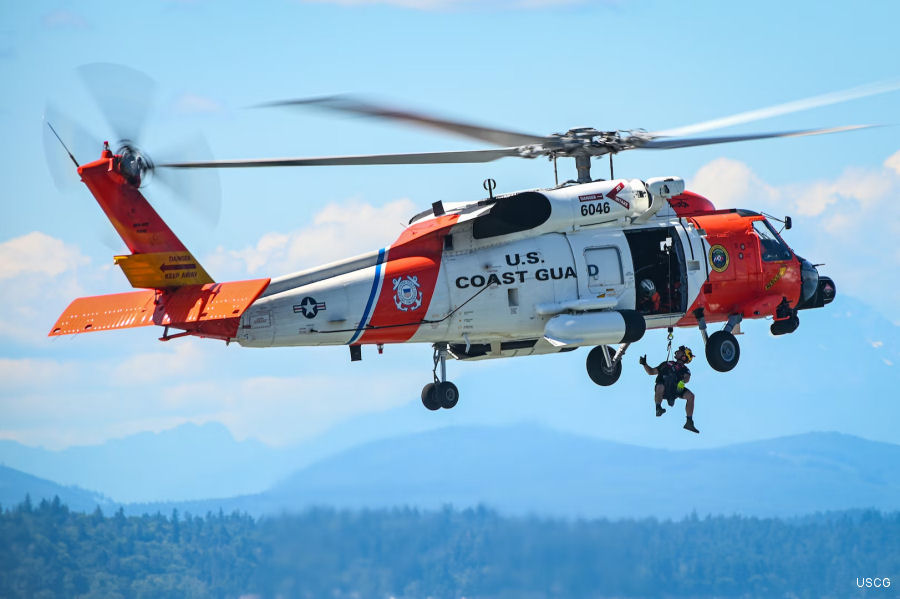
US Coast Guard to Expand MH-60 Jayhawk Fleet
The U.S. Coast Guard will acquire new Sikorsky MH-60 Jayhawk helicopters to complete the transition of several air stations from the MH-65E Dolphin, with the purchases funded through budget authority and recapitalization money in the One Big Beautiful Bill Act (OBBBA)
The U.S. Coast Guard (USCG) is in the process of retiring its long-serving fleet of MH-65 Dolphin helicopters and replacing them with the larger, more capable MH-60 Jayhawk. The MH-65, a variant of the Eurocopter Dauphin, has been the Coast Guard’s short-range recovery workhorse since the 1980s, but rising maintenance costs, aging airframes, and limited range have driven the transition. By consolidating on the MH-60 platform, the Coast Guard gains longer endurance, greater lift capacity, and commonality with the Navy’s Seahawk family, which reduces logistics and training burdens. The transition is being phased in over the decade, with air stations gradually swapping out MH-65s for MH-60s, ensuring uninterrupted coverage for critical missions such as search and rescue, drug interdiction, and homeland security.

Did you know?
- The One Big Beautiful Bill Act (OBBBA), signed into law on July 4, 2025, is a sweeping package that makes permanent the 2017 Trump tax cuts while adding new deductions (for overtime, tips, and auto loans on U.S.-built cars), creating ‘Trump Accounts’ for children, and introducing a 1% excise tax on remittances abroad. At the same time it rolls back many clean-energy credits, mandates more public land leasing, raises the debt ceiling by $5 trillion, imposes stricter work requirements and cost-sharing on Medicaid and SNAP, and expands defense and homeland security funding, including Coast Guard recapitalization programs. These changes, which the CBO projects could leave millions without health coverage, have sparked sharp debate over the bill’s deficit impact, distributional fairness, and long-term sustainability