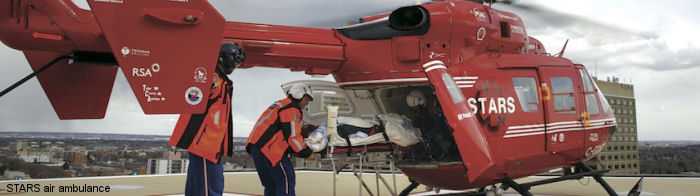

Nonprofit helicopter rescue service formed in Calgary, Alberta in 1985.
STARS Air Ambulance, which stands for Shock Trauma Air Rescue Service, began its operations on December 1, 1985, in Calgary, Alberta as Lions Air Ambulance Service flying a white Bk117 helicopter with the Lions logo on it, which served as the cornerstone of their early missions. The organization was founded by Dr. Gregory Powell, an emergency room physician who recognized the critical need for rapid medical transport for critically ill and injured patients, particularly those in rural areas. His experience as a physician on Mobile Army Surgical Hospital (MASH) units during the Vietnam War heavily influenced his vision for an air ambulance service.
Over the years, STARS gradually expanded its fleet and its operational reach. The 1990s and early 2000s saw the introduction of additional aircraft types, including the MBB Bo105 and the AgustaWestland AW139. Fixed-wing aircraft, such as the Mitsubishi Marquise MU-2, were also utilized for a period, though the focus eventually shifted exclusively to helicopters for scene calls and critical care transport.
STARS has since grown to operate across Western Canada, with bases in Alberta, Saskatchewan, and Manitoba. A significant fleet renewal program commenced in 2018, leading to the gradual replacement of older models with the Airbus H145 helicopter. This modernized fleet features advanced medical interiors, enhanced flight capabilities, and sophisticated avionics, allowing for more rapid response times, expanded service areas, and improved critical care delivery. The organization's mission has consistently centered on providing critical care anywhere, whether by air, ground, or virtually, and it remains a not-for-profit entity largely supported by community donations.
STARS Operating bases
Calgary (STAR-1) at Calgary Intl Airport, AB
Edmonton (STAR-3) at Edmonton Intl Airport, AB
Grande Prairie (STAR-5) at Grande Prairie Airport, AB
Winnipeg (STAR-7) at James Armstrong Richardson Intl Airport, MB
Regina (STAR-9) at Regina Airport, SK
Saskatoon (STAR-11) at John G Diefenbaker Airport, SK
They leave a one-number gap in order to identify training aircraft, or specially-assigned aircraft outside normal operations, e.g. STAR-3 identifies the mission-ready Edmonton aircraft, so STAR-4 could be a pilot training flight that may be occurring at the same time.
As of 2025, STARS operates a fleet of five H145D3 and five upgraded H145D2
STARS Air Ambulance, which stands for Shock Trauma Air Rescue Service, began its operations on December 1, 1985, in Calgary, Alberta as Lions Air Ambulance Service flying a white Bk117 helicopter with the Lions logo on it, which served as the cornerstone of their early missions. The organization was founded by Dr. Gregory Powell, an emergency room physician who recognized the critical need for rapid medical transport for critically ill and injured patients, particularly those in rural areas. His experience as a physician on Mobile Army Surgical Hospital (MASH) units during the Vietnam War heavily influenced his vision for an air ambulance service.
Over the years, STARS gradually expanded its fleet and its operational reach. The 1990s and early 2000s saw the introduction of additional aircraft types, including the MBB Bo105 and the AgustaWestland AW139. Fixed-wing aircraft, such as the Mitsubishi Marquise MU-2, were also utilized for a period, though the focus eventually shifted exclusively to helicopters for scene calls and critical care transport.
STARS has since grown to operate across Western Canada, with bases in Alberta, Saskatchewan, and Manitoba. A significant fleet renewal program commenced in 2018, leading to the gradual replacement of older models with the Airbus H145 helicopter. This modernized fleet features advanced medical interiors, enhanced flight capabilities, and sophisticated avionics, allowing for more rapid response times, expanded service areas, and improved critical care delivery. The organization's mission has consistently centered on providing critical care anywhere, whether by air, ground, or virtually, and it remains a not-for-profit entity largely supported by community donations.
STARS Operating bases
Calgary (STAR-1) at Calgary Intl Airport, AB
Edmonton (STAR-3) at Edmonton Intl Airport, AB
Grande Prairie (STAR-5) at Grande Prairie Airport, AB
Winnipeg (STAR-7) at James Armstrong Richardson Intl Airport, MB
Regina (STAR-9) at Regina Airport, SK
Saskatoon (STAR-11) at John G Diefenbaker Airport, SK
They leave a one-number gap in order to identify training aircraft, or specially-assigned aircraft outside normal operations, e.g. STAR-3 identifies the mission-ready Edmonton aircraft, so STAR-4 could be a pilot training flight that may be occurring at the same time.
As of 2025, STARS operates a fleet of five H145D3 and five upgraded H145D2
| ||||||||||||||||||||||||||||||||||||||||||||
 Models