
History
Photos
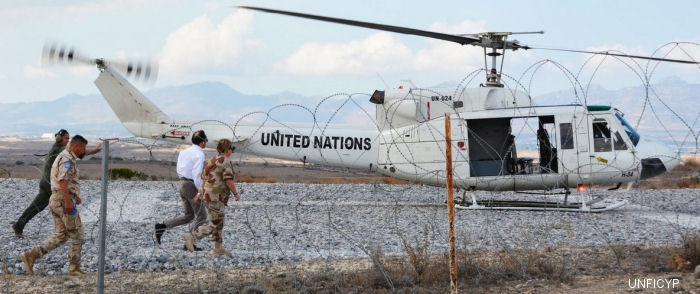
Established to contribute to the United Nations UNFICYP mission to Cyprus in Sep 1994. Although composed of Argentinean troops and equipment, the Flight is tasked by UNFICYP HQ in Nicosia (Lefkosia).
Took over UNFICYP flying duties from the UK contingent on 30 Sep with its 2x MD500 airframes, after they were air freighted in by FAA C-130 to Larnaca on 15 Sep 1994.
By Oct 2011 the team from VII Brigada Aerea had achieved over 20,000 flying hours for UNFICYP.
Took over UNFICYP flying duties from the UK contingent on 30 Sep with its 2x MD500 airframes, after they were air freighted in by FAA C-130 to Larnaca on 15 Sep 1994.
By Oct 2011 the team from VII Brigada Aerea had achieved over 20,000 flying hours for UNFICYP.
In November 2020, FAA Bell 212 and Hughes 500 helicopters attached to the UNFICYP Flight achieved 30,000 flight hours
The Argentine Air Force has maintained a continuous and distinctive presence in the United Nations Peacekeeping Force in Cyprus (UNFICYP) since September 1994, when it was selected by the UN to replace the British Army Air Corps helicopter squadron that had supported the mission for nearly three decades. Deployed as the UN Flight Unit (commonly known as ARGAIR), this component operates from the abandoned Nicosia International Airport within the buffer zone and consists of approximately 35 personnel from the Argentine Air Force, forming an integral part of the broader Argentine contingent. The unit is equipped with three helicopters—typically two Hughes 500 light observation and scout helicopters and one Bell 212 twin-engine utility helicopter—sourced from the VII Air Brigade. Two of these aircraft remain operational at all times, enabling round-the-clock availability unique among UN peacekeeping aviation units. This long-term commitment, now exceeding 30 years, has seen Argentine helicopters accumulate tens of thousands of flight hours (over 28,000 by 2019) in accident-free operations, underscoring the high professionalism and reliability of the crews trained in diverse environments ranging from Antarctica to Patagonia.
The primary roles of these Argentine Air Force helicopters in Cyprus focus on surveillance, mobility, and emergency response along the buffer zone separating the Greek Cypriot and Turkish Cypriot areas. They conduct regular aerial patrols to monitor cease-fire lines, detect potential violations, and provide real-time situational awareness to ground forces. The Bell 212 supports logistical transport, troop insertion for rapid response (including air-mobile operations with the Mobile Force Reserve), and medical evacuations, while the Hughes 500 platforms excel in close observation and reconnaissance tasks. This aviation support enhances UNFICYP's overall mandate to maintain peace, prevent incidents, and facilitate confidence-building measures in a stable but divided island. The unit's multinational character—occasionally involving coordination with other contingents—and its basing at a symbolically significant, non-civilian airport highlight Argentina's enduring contribution to UN peacekeeping in the region.
The primary roles of these Argentine Air Force helicopters in Cyprus focus on surveillance, mobility, and emergency response along the buffer zone separating the Greek Cypriot and Turkish Cypriot areas. They conduct regular aerial patrols to monitor cease-fire lines, detect potential violations, and provide real-time situational awareness to ground forces. The Bell 212 supports logistical transport, troop insertion for rapid response (including air-mobile operations with the Mobile Force Reserve), and medical evacuations, while the Hughes 500 platforms excel in close observation and reconnaissance tasks. This aviation support enhances UNFICYP's overall mandate to maintain peace, prevent incidents, and facilitate confidence-building measures in a stable but divided island. The unit's multinational character—occasionally involving coordination with other contingents—and its basing at a symbolically significant, non-civilian airport highlight Argentina's enduring contribution to UN peacekeeping in the region.

Locations
| 1994- | LCNC NIC |  Nicosia (Lefkosia) International Airport Nicosia (Lefkosia) International Airport |
Models
| 1994- | 369 / 500 / H-6 |
| 1998- | 212 |
Operations
| 30 Sep 19941994 | -- | UNFICYP |