 Carabinieri
Italian Gendarmerie
History
Tracking

The Carabinieri (Arma dei Carabinieri) is Italy's national gendarmerie, a military force with civilian police duties that has existed for over 200 years. Founded in 1814 by King Victor Emmanuel I, the corps is older than the unified Italian state and played a pivotal role in the Risorgimento (Italian unification). In 2000, it was elevated from a branch of the Army to become the fourth independent branch of the Italian Armed Forces, alongside the Army, Navy, and Air Force. Its name is derived from the "carbine" rifles its early members traditionally carried.
The force operates under a unique dual mandate: it serves as the military police for the Italian armed forces under the Ministry of Defence, while simultaneously performing general domestic law enforcement under the Ministry of the Interior. Key roles and characteristics include:
- Capillary Presence: Unlike the civilian State Police (Polizia di Stato), which focuses on larger urban centers, the Carabinieri maintains over 4,600 stations across the country, ensuring a presence in nearly every small village and rural community.
- Specialized Commands: The corps includes highly specialized units for environmental and forestry protection, health safety, labor policing, and the protection of cultural heritage.
- International Peacekeeping: The Carabinieri is a leading international provider of "Stability Policing," training foreign police forces and participating in global missions with organizations like NATO and the UN.
- La Benemerita: Known colloquially as "The Meritorious," the force is a deeply respected cultural institution in Italy, often the first to respond during natural disasters like floods or earthquakes
The Carabinieri Aviation Service (Servizio Aereo Carabinieri) traces its tactical roots back to World War II with the establishment of the 1st Royal Carabinieri Paratroopers Battalion on July 1, 1940. While early units were primarily focused on air assault and parachuting duties, the formal aviation component as a specialized air support service was officially established much later. The service began integrating its own dedicated flight assets in 1960 with the arrival of its first helicopters. This modernization marked a shift from relying on external military transport to maintaining an organic aerial capability for specialized police tasks, including search and rescue, environmental monitoring, and anti-terrorism operations.
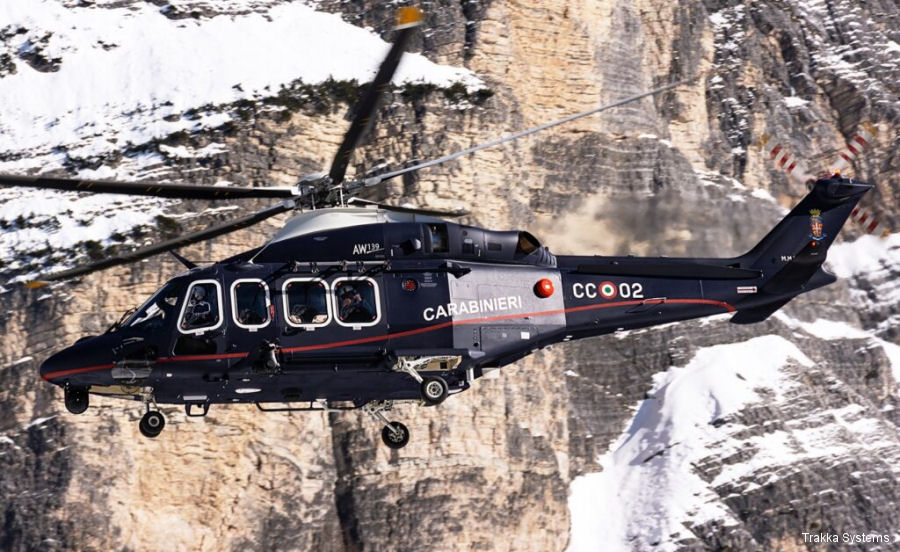
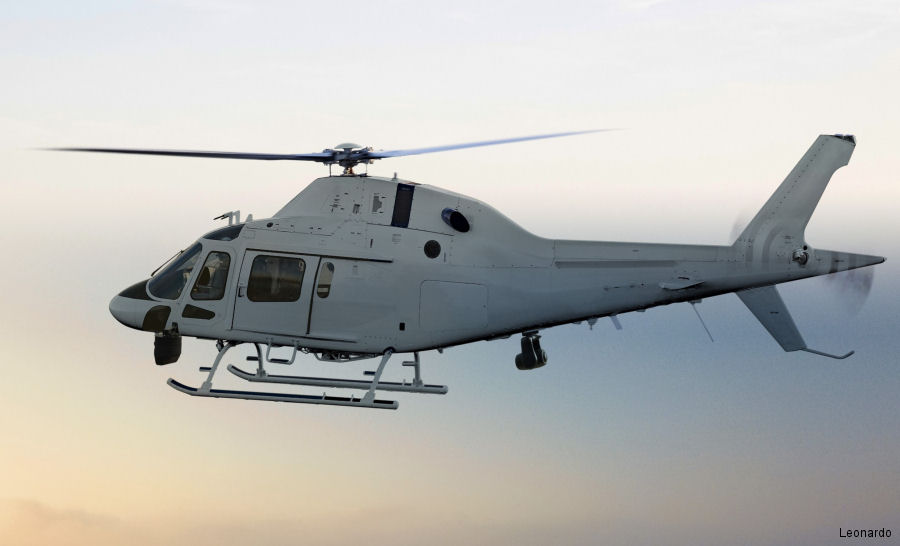
Today, the aviation component is organized under the Carabinieri Aircraft Group (Raggruppamento Aeromobili Carabinieri), based at the Pratica di Mare Air Base near Rome. This command coordinates 16 peripheral helicopter units strategically distributed across Italy to ensure a response time of approximately 30 minutes for any part of the national territory. The modern fleet consists of dozens of helicopters, such as the AgustaWestland AW139 and the newly introduced AW119Kx, as well as fixed-wing aircraft like the Piaggio P180 Avanti, used for rapid transport and advanced surveillance. These assets provide critical support to ground units, including the elite paratrooper regiment "Tuscania" and the Special Intervention Group (GIS).
Fiamma (meaning "Flame") is the official radio callsign used by the Carabinieri Aviation Service. It is directly derived from the traditional "granata fiammeggiante" (flaming grenade) emblem of the Carabinieri.
The force operates under a unique dual mandate: it serves as the military police for the Italian armed forces under the Ministry of Defence, while simultaneously performing general domestic law enforcement under the Ministry of the Interior. Key roles and characteristics include:
- Capillary Presence: Unlike the civilian State Police (Polizia di Stato), which focuses on larger urban centers, the Carabinieri maintains over 4,600 stations across the country, ensuring a presence in nearly every small village and rural community.
- Specialized Commands: The corps includes highly specialized units for environmental and forestry protection, health safety, labor policing, and the protection of cultural heritage.
- International Peacekeeping: The Carabinieri is a leading international provider of "Stability Policing," training foreign police forces and participating in global missions with organizations like NATO and the UN.
- La Benemerita: Known colloquially as "The Meritorious," the force is a deeply respected cultural institution in Italy, often the first to respond during natural disasters like floods or earthquakes
The Carabinieri Aviation Service (Servizio Aereo Carabinieri) traces its tactical roots back to World War II with the establishment of the 1st Royal Carabinieri Paratroopers Battalion on July 1, 1940. While early units were primarily focused on air assault and parachuting duties, the formal aviation component as a specialized air support service was officially established much later. The service began integrating its own dedicated flight assets in 1960 with the arrival of its first helicopters. This modernization marked a shift from relying on external military transport to maintaining an organic aerial capability for specialized police tasks, including search and rescue, environmental monitoring, and anti-terrorism operations.
Today, the aviation component is organized under the Carabinieri Aircraft Group (Raggruppamento Aeromobili Carabinieri), based at the Pratica di Mare Air Base near Rome. This command coordinates 16 peripheral helicopter units strategically distributed across Italy to ensure a response time of approximately 30 minutes for any part of the national territory. The modern fleet consists of dozens of helicopters, such as the AgustaWestland AW139 and the newly introduced AW119Kx, as well as fixed-wing aircraft like the Piaggio P180 Avanti, used for rapid transport and advanced surveillance. These assets provide critical support to ground units, including the elite paratrooper regiment "Tuscania" and the Special Intervention Group (GIS).
Fiamma (meaning "Flame") is the official radio callsign used by the Carabinieri Aviation Service. It is directly derived from the traditional "granata fiammeggiante" (flaming grenade) emblem of the Carabinieri.
Units
Locations
| 2017- | Aeroporto di Rieti “Giuseppe Ciuffelli" | LIQN |
| 2017- | Arturo dell'Oro | LIDB |
| 2017- | Aeroporto di Roma-Urbe | LIRU |
| 2016- | Abruzzo International Airport | LIBP |
| 1998- | Albenga | LIMG |
| 1995-2017 | Treviso-Sant'Angelo | LIPH |
| 1993- | Distaccamento Carabinieri di Abbasanta | |
| 1992- | Forlì Airport | LIPK |
| 1985- | Aeroporto di Catania-Fontanarossa Vincenzo Bellini | LICC |
| 1983- | 1° Nucleo Elicotteri Carabinieri, Volpiano - Torino | |
| 1976- | Olbia-Venafiorita Airport | LIEV |
| 1976- | Bari Karol Wojtyla International Airport | LIBD |
| 1973- | Pontecagnano | LIRI |
| 1973- | Aeroporto Internationale Galileo Galilei | LIRP |
| 1972-2012 | Ancona Falconara | LIPY |
| 1969- | Vibo Valentia Luigi Razza Heliport | LIBJ |
| 1968- | Aeroporto Internazionale Il Caravaggio | LIME |
| 1968-1976 | Foggia Gino Lisa | LIBF |
| 1966-1983 | Aeritalia | LIMA |
| 1965- | Elmas | LIEE |
| 1965- | Aeroporto di Boccadifalco | LICP |
| 1965- | Dolomiti | LIPB |
| Pratica di Mare Base Aerea Mario De Bernardi | LIRE | |
| Caselle | LIMF |
Models
| 2023- | AW119Kx Koala |
| 2022- | AW169 (skids) |
| 2020- | AW139 |
| 2016- | NH500 |
| 2007- | AW109 |
| 2000- | A109E Power |
| 1987- | AB412 |
| 1979-2013 | A109 |
| 1974-2011 | AB206 |
| 1974-1998 | AB205 |
| 1963-?? | AB204 |
| 1960-1981 | AB47 |
Operations
| 04 Sep 20172017 | 08 Sep 20172017 | Grifone 2017 |
| 05 Sep 20112011 | 09 Sep 20112011 | Grifone (Griffin) 2011 |