
Was during World War II, due to the insistence of several Coast Guards officers, that the helicopter was developed for war and peacetime uses.
Their efforts helped this new revolutionary aircraft to evolve into the machine that is known today.
 1940, May 13 : Igor I. Sikorsky's flew his
VS-300 helicopter for the first time in a public demonstration. Commander William J. Kossler,
US Coast Guard, was an observer and began plans for its use by the Coast Guard.
1942, April 20:
Igor Sikorsky flew the R-4/HNS in a new demonstration. Kossler was there once again to witness this flight. He
would spend the rest of his life devoted to an aviation organization built
around the helicopter for use by the Coast Guard.
1942, June 29 :
Following an inspection of Igor I. Sikorsky's
VS-300 helicopter on 26 June,
Lieutenant Commander F. A. Erickson, US Coast Guard, recommended that
helicopters be obtained for antisubmarine convoy duty and life-saving.
1942, July 24:
The US Bureau of Aeronautics issued a Planning Directive calling for procurement of four Sikorsky helicopters for study and development by US Navy and US Coast Guard aviation forces.
1940, May 13 : Igor I. Sikorsky's flew his
VS-300 helicopter for the first time in a public demonstration. Commander William J. Kossler,
US Coast Guard, was an observer and began plans for its use by the Coast Guard.
1942, April 20:
Igor Sikorsky flew the R-4/HNS in a new demonstration. Kossler was there once again to witness this flight. He
would spend the rest of his life devoted to an aviation organization built
around the helicopter for use by the Coast Guard.
1942, June 29 :
Following an inspection of Igor I. Sikorsky's
VS-300 helicopter on 26 June,
Lieutenant Commander F. A. Erickson, US Coast Guard, recommended that
helicopters be obtained for antisubmarine convoy duty and life-saving.
1942, July 24:
The US Bureau of Aeronautics issued a Planning Directive calling for procurement of four Sikorsky helicopters for study and development by US Navy and US Coast Guard aviation forces.
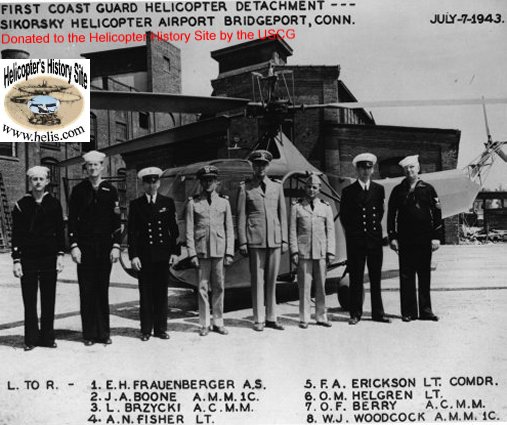 1943, February 15 :
The Commander in Chief US Fleet, Admiral King, assigned responsibility for sea-going
development of helicopters and their operation in convoys to the Coast Guard
and directed that tests be carried out to determine if helicopters operating from
merchant ships would be of value in combating submarines.
1943, June 10 :
Erickson, proposed that helicopters be developed for antisubmarine warfare,
To this end he recommended that helicopters be equipped with radar and dunking sonar.
1943, February 15 :
The Commander in Chief US Fleet, Admiral King, assigned responsibility for sea-going
development of helicopters and their operation in convoys to the Coast Guard
and directed that tests be carried out to determine if helicopters operating from
merchant ships would be of value in combating submarines.
1943, June 10 :
Erickson, proposed that helicopters be developed for antisubmarine warfare,
To this end he recommended that helicopters be equipped with radar and dunking sonar.
"not as a killer craft but as the eyes and ears of the convoy escorts."
1943, December 18 :
On the basis of his belief that tests indicated the practicability of ship-based
helicopters, the US Chief of Naval Operations separated the pilot training from
test and development functions in the helicopter program. He directed that,
effective 1 January 1944, a helicopter pilot training program be conducted by
the US Coast Guard at Floyd Bennett Field, under the direction of the Deputy
Chief of Naval Operations (Air).
1944, January 3:
The first US recorded helicopter
lifesaving operation
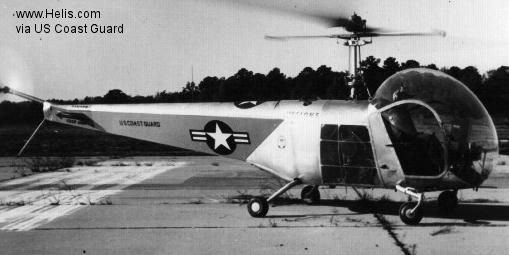 1944, January 16 :
Lieutenant Junior Grade Stewart R. Graham, US Coast Guard, made the first
anti-submarine patrol from the british freighter Daghestan in mid-Atlantic
during a convoy from United States to England flying a Royal Navy R-4.
1944, January 16 :
Lieutenant Junior Grade Stewart R. Graham, US Coast Guard, made the first
anti-submarine patrol from the british freighter Daghestan in mid-Atlantic
during a convoy from United States to England flying a Royal Navy R-4.
Between March 3rd 1944 and December that year, at Floyd Bennett Field along with the USCG staff, 4 courses of RN and RAF trainees were introduced to the R-4 (Hoverfly in British service ). On December 30, the 10 Hoverflies were shipped to Britain (Faslane, Scotland) aboard HMS Thane.
1945: Bell 47
The Coast guard had two
Bell HTL-1 on wheels
One was based at USCG Air Station Traverse City, Mich. and the other at USCG Air Station Miami, Fla. Most of the Traverse City helicopter was on the Icebreaker Mackinaw on the Great lakes and the other on the CGC Eastwind in Greenland and Ellesmere Island in the far North of Canada. Both were lost in crashes.
1946-1948: Sikorsky XR-4C, S-51 ( HO3S-1G ) and Piasecki PV-17 ( HRP-1 )

|

|
April 6, 1949:
US Coast Guard H035-l (HO3S-1G) completed the longest unescorted helicopter ferry flight on
record. The trip from Elizabeth City, North Carolina, to Port Angeles, Washington,
via San Diego, California, a distance of 3,750 miles, took 10 1/2 days to complete
and involved a total flight time of 57.6 hours.
|
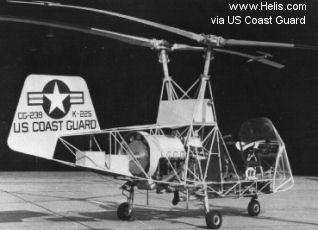
1949: Kaman K-225 ( HTK / H-22 Mixmaster )
The Coast Guard buy one ( $25,000 ) for evaluation.
1951:
Sikorsky S-55 ( HO4S-2G/3-G / HH-19G Chickasaw )
|
|
|
1956: Sikorsky S-58 HUS-1G / HH-34F Sea Horse |

|
1959: Sikorsky S-62. The HH-52 Sea Guard was the
United States Coast Guard first turbo shaft helicopter.
| The photo pictured is a US Coast Guard HH-52A which was put in service with the original 3 blade system that came from the S-55(H-19). The Coast Guard bought 96 of the "A" model and flew them from approximately 1961 to 1985. The model was retired with the same designation HH-52A it received originally. The paint scheme pictured was the first of several styles. In 1967 the aircraft received the new red, white and blue "slash" the Coast Guard still retains. HH-52's that were deployed to the ice caps on ice breakers were painted orange with a white "slash" on the tail. This tradition is still praticed today. |

|
1966:
Sikorsky S-61 ( HH-3F Pelican ) 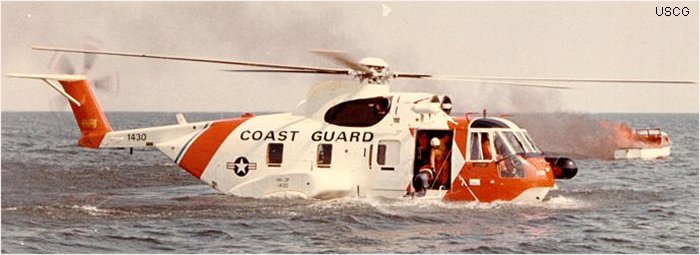
|
1979:
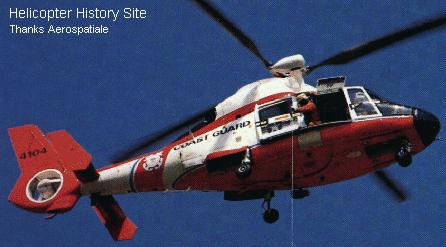
Aerospatiale HH-65 Dolphin
In order to comply with US law, the majority of the helicopters value had to be produced locally, most notably the substitution of Avco Lycoming engines in place of the original Turbom�ca units |
|
|
Back to Part 2 ', $pathdir ); ?>
1986:
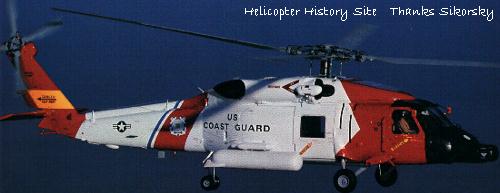
HH-60J JayHawk.
The HH-60J is a member of the Sikorsky S-70 family and is based on the US Navy SH-60 Seahawk.
|
|
|
1999, May :
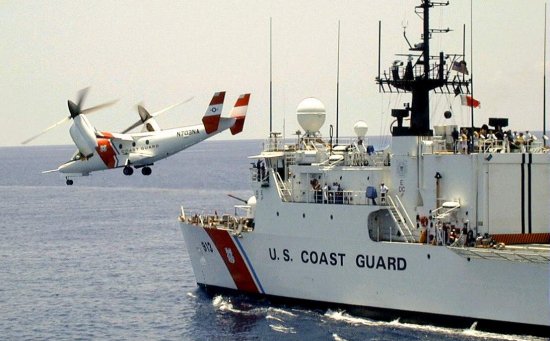
Bell XV-15 ( HV-609 )
Using the XV-15 Tiltrotor, a
compatibility test was demonstrated on board a 270
foot USCG cutter, underway south of Key West, Florida.
The test proved that deck compatibility is expected with the
BA609.
|
|
|
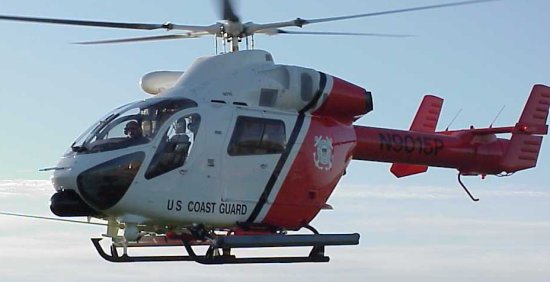
MH-90 Enforcer
McDonnell Douglas/Boeing MD900 Explorer under evaluation |
|
1999, Sept. 13:
US Coast Guard Fires at Drug Boats
2000, Sept:
The US Coast Guard is acquiring under 2 year lease, a number of
Agusta
A109E Power helicopters for Go-Fast drug interdiction, to be based at
Cecil Field, Jacksonville, Florida.
 2001, December:
Members of The US Coast Guard, and Agusta Aerospace Corporation, pose in
front of, one of the eight, specially built variants of the A109 POWER.
Designated the MH-68 Mako, this ship's mission equipment includes a rescue hoist,
emergency floats, .50-caliber sniper rifle, M240 machine gun, night vision goggles, FLIR,
Light Eye, and NightSun searchlight. Avionics include a fully integrated avionics suite,
HUD, and GPS moving map. The Makos are powered by two FADEC-equipped
Pratt & Whitney Canada
2001, December:
Members of The US Coast Guard, and Agusta Aerospace Corporation, pose in
front of, one of the eight, specially built variants of the A109 POWER.
Designated the MH-68 Mako, this ship's mission equipment includes a rescue hoist,
emergency floats, .50-caliber sniper rifle, M240 machine gun, night vision goggles, FLIR,
Light Eye, and NightSun searchlight. Avionics include a fully integrated avionics suite,
HUD, and GPS moving map. The Makos are powered by two FADEC-equipped
Pratt & Whitney Canada
|
 2002, March:
Agusta MH-68
The Coast Guard selected the A109E Power as its choice for an armed,
anti-narcotics helicopter.
The service entered into a lease agreement for eight of the Italian made "Mako" armed
interdiction helicopters to support its law enforcement functions. The program is
expected to cost approximately $18 million.
2002, March:
Agusta MH-68
The Coast Guard selected the A109E Power as its choice for an armed,
anti-narcotics helicopter.
The service entered into a lease agreement for eight of the Italian made "Mako" armed
interdiction helicopters to support its law enforcement functions. The program is
expected to cost approximately $18 million.
Although was called "Mako" by Agusta, there was not an official name for the MH-68A until 2003 Assigned to Helicopter Interdiction Tactical Squadron 10 (HITRON-10), based at Cecil Air Field in Jacksonville, FL. |
 2002, September: VUAV
Selection of the vertical Unmanned Aerial Vehicle element of the US Coastguard s
major Deepwater re-equipment programme is required within the next year, so it can be ready
for use by 2006 when new coastguard cutters are scheduled to enter service.
Initial Deepwater UAV validation studies are due in December 2002.
2002, September: VUAV
Selection of the vertical Unmanned Aerial Vehicle element of the US Coastguard s
major Deepwater re-equipment programme is required within the next year, so it can be ready
for use by 2006 when new coastguard cutters are scheduled to enter service.
Initial Deepwater UAV validation studies are due in December 2002.
VUAVs will provide a key sensor capability for the coastguard. The US$11 billion Deepwater project requires 69 VUAVs, and Bell s Eagle Eye > tiltrotor UAV was included in the ICGS package selected earlier this year. However, Northrop Grumman Fire Scout is also believed to be once again under consideration.
2002, November: VUAV
Bell Helicopter Textron will remodel its HV-911 Eagle Eye unmanned
aerial vehicle (UAV) production version in preparation for the US Coast Guard
Integrated Deepwater System Program (ISDP) contract announcement.
In an effort to reduce signature the redesign is said to include the airframe,
and possibly a new engine.
|
2003:
The USCG MH-68A is officially named Stingray
2004, March 8:
Bell Eagle Eye UAV tilt rotor reachs Critical Milestone For the U.S. Coast Guard Deepwater Program
2005: Hurricane Katrina relief efforts