
Formed at Beaulieu in Hampshire on 1 Sep 1917 as a light bomber unit, it served until just after WWI when it was disbanded. It was reformed under the RAF expansion plan in 1936, as a bomber squadron and served with distinction in WWII. It ended its fixed wing life with Canberra B.2 at RAF Gütersloh on 1 Aug 1956.
103 Squadron reformed in Aug 1959 with the Sycamore HR.14 from 284 Squadron at RAF Nicosia, where it provided air mobility to the security forces on Cyprus. On 31 Jul 1963 it was split into 1563 Flight (remaining at Nicosia) and 1564 Flight (departed to El Adem) and disbanded.
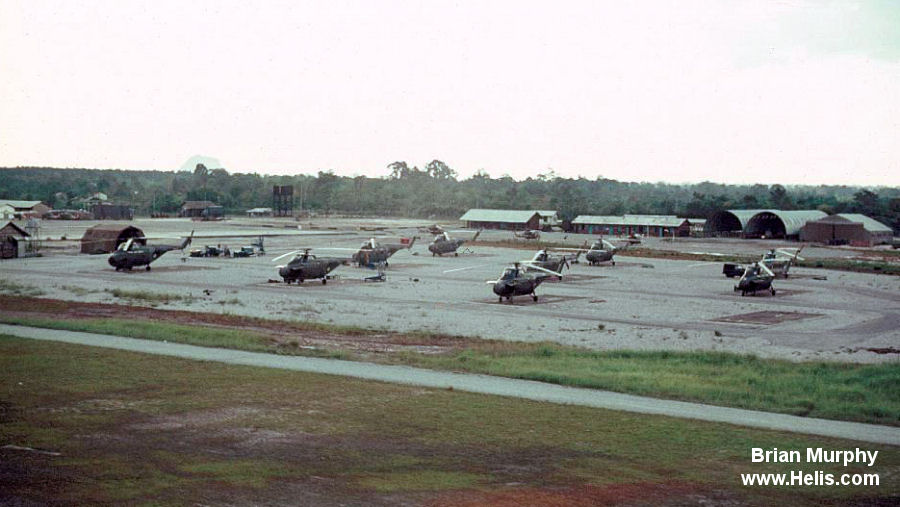
The very next day, the 103 Squadron number plate was in use again when it reformed from the Whirlwind HAR.10 of B Flight, 110 Squadron at RAF Seletar in Singapore. It maintained detachments at Tawau where it relieved 846 NAS Whirlwind HAS.7s in Apr 1964, Kuching (see image above), Labuan and Kai Tak and took over SAR cover from 110 Squadron with a detachment at Butterworth between Aug 1965 and Mar 1967.
It received a boost in numbers on 1 Nov 1965 when some of the ex-225 Squadron Whirlwinds and crews were reassigned. The unit moved to RAF Changi in Mar 1969 and it finally moved to RAF Tengah in Sep 1971. This was followed by the arrival of the Wessex HC.2 in Nov 1972 and its last Whirlwind departed during Dec. It was disbanded on 1 Aug 1975.
The very next day, the 103 Squadron number plate was in use again when it reformed from the Whirlwind HAR.10 of B Flight, 110 Squadron at RAF Seletar in Singapore. It maintained detachments at Tawau where it relieved 846 NAS Whirlwind HAS.7s in Apr 1964, Kuching (see image above), Labuan and Kai Tak and took over SAR cover from 110 Squadron with a detachment at Butterworth between Aug 1965 and Mar 1967.
It received a boost in numbers on 1 Nov 1965 when some of the ex-225 Squadron Whirlwinds and crews were reassigned. The unit moved to RAF Changi in Mar 1969 and it finally moved to RAF Tengah in Sep 1971. This was followed by the arrival of the Wessex HC.2 in Nov 1972 and its last Whirlwind departed during Dec. It was disbanded on 1 Aug 1975.
Aircraft were built from boxes at Seletar from end of 1962 . The squadron was operational within about 8 months and the first aircraft went to Kuching aboard HMS Albion when the Confrontation began. They then moved to Labuan and we did have a one aircraft deployment to Sibu until we were relieved by the Royal Navy
Sep 18, 1970 - During the Changi period a ceremony took place for the consecration and presentation of the squadron standard. The presenting officer was Air Chief Marshall The Earl of Bandon GBE CB CVO DSO RAF (Retired). Officer Commanding No 103 Squadron was Squadron Leader P R Bond.
Locations
| 1959-1963 | LCNC NIC |  Nicosia (Lefkosia) International Airport Nicosia (Lefkosia) International Airport |
| 1963-1969 | WSSL XSP |  Seletar Seletar |
| 1965-1967 | WMKB BWH |  RMAF Butterworth RMAF Butterworth |
| 1969-1971 | WSSS SIN | Changi International Airport |
| 1971-1975 | WSAT TGA | Tengah |
Models
| 1959-1963 | Type 171 Sycamore |
| 1963-1972 | Whirlwind HAR.10 |
| 1972-1975 | Wessex HC.2 |
Operations
| 01 Aug 19631963 | 11 Aug 19661966 | Konfrontasi |
Airframes (19)
| Reg | Model | C/N | Built | |
|---|---|---|---|---|
| XE307 | sycamore 4 | 13145 | 1952 | |
| XG511 | sycamore 4 | 13271 | 1955 | |
| XG512 | sycamore 4 | 13272 | 1955 | |
| XG517 | sycamore 4 | 13371 | 1955 | |
| XJ897 | sycamore 4 | 13406 | 1956 | |
| XK987 | har.2 | wa143 | 1956 | B |
| XK988 | har.2 | wa144 | 1956 | |
| XN126 | hcc.8 | wa266 | 1959 | |
| XP339 | har10 | wa355 | 1961 | |
| XP358 | har10 | wa374 | 1962 | |
| XP361 | har10 | wa377 | 1962 | |
| XP362 | har10 | wa378 | 1962 | |
| XP398 | har10 | wa386 | 1962 | |
| XP400 | har10 | wa388 | 1962 | |
| XR478 | har10 | wa410 | 1963 | |
| XR480 | har10 | wa412 | 1963 | |
| XR482 | har10 | wa414 | 1963 | |
| XR483 | har10 | wa415 | 1963 | |
| XT604 | hc.2 | wa531 | 1966 |