 Fleet Air Arm (RAN)
Royal Australian Navy
RAN
The Royal Australian Navy came into being on 10 Jul 1911, following an earlier phase as a Commonwealth Force and in Oct 1913, formal control of that fleet passed to Australia. It served with distinction during the two World Wars and played a key role in the Korean, Vietnam and Gulf wars. The RAN Fleet Air Arm emerged in 1947. The modern RAN is an active supporter of UN peacekeeping operations.
The decision to form a Fleet Air Arm of the RAN was approved by the Australian Government on 15 Aug 1947. It was to consist of two aircraft carriers operating 3 air groups (of Sea Fury and Firefly) with two shore bases in support and would consist of 4000 naval personnel. Initially it was to be supplemented by ex Royal Navy FAA personnel and initial specialist training would be carried out in the UK, whilst the RAN was building up its local facilities and expertise.
HMAS Albatross was commissioned on 31 Aug 1948 at RANAS Nowra as a shore base. HMAS Sydney (Australia's first light fleet carrier) left the UK for Australia on 12 Apr 1949 with the 20th Carrier Air Group embarked, arriving in Jervis Bay on 25 May 1949.
A plane guard Dragonfly was initially loaned to HMAS Sydney from 27 Sep 1951 during operations in Korea from HMS Glory, later replaced by a USN HO3S-1. Bristol Sycamores appeared when 3 Mark 50s arrived off Garden Island, Sydney aboard HMS Vengeance (on loan to the RAN from the Royal Navy while HMAS Sydney was re-fitting) and flew off on 11 Mar 1953 to form the first ever Australian helicopter squadron at Nowra.
It was during 1953/54 that shortages of trained man power, budget constraints, a lack of clear focus of the naval aviation role and a lack of political will all combined to begin a slow decline in the RAN Aviation Branch. HMAS Sydney was already obsolete when completed and would not be modernised, Vengenace was only on loan, HMAS Melbourne had not yet been delivered and there was dithering over the balance between strike and anti-submarine warfare capabilities. Melbourne commissioned in Oct 1955 with a semi-angled flight deck, steam catapult and a complement of Sea Venom and Gannet and arrived in Sydney in May 1956. HMAS Sydney became a training carrier and the RAN was down to one operational carrier. She could never afford more.
As the transition to fixed wing jet aircraft rolled on, around 1955 plans to replace the Gannet with ASW helicopters in 1961 had been approved. The Wessex was evaluated with an eye to being able to remove its ASW fit for use as an assault helicopter, and back again. Melbourne, with some modification could serve also in the Commando carrier role, proven as a concept at Suez.
By 1958/59 there was competition to provide air support for the fleet from the RAAF and serious doubt in government whether the RAN Fleet Air Arm would survive past 1963, when current fixed wing aircraft would require replacement. Looking to the US rather than to Britain for small fixed wing types and extending the operational life of its carrier seemed like the best solution if it could be driven through despite dwindling budgets, political opposition and inter-service rivalries. It entered the 1960s in considerable uncertainty. Then in June 1961 after a huge effort by the Naval Staff, the Wessex was ordered, two Scouts were supplied for coastal survey work in 1963 and after rejecting the Wasp, the UH-1B was ordered to provide initial training for the Wessex crews.
By Nov 1967 with a war in Vietnam uncomfortably close to Australia, the RAAF's bluff had been called and was found wanting, RAN pilots were being trained in the US and Canada, HMAS Melbourne had re-equipped with A-4 Skyhawks and S-2 Trackers, an upgrading to the facilities at Nowra had started and whilst the improved Wessex 31B had started to appear, its replacement was already being planned for around 1972.
By Mar 1971, the on-off commitment with Australias aircraft carriers looked on again with a replacement programme for HMAS Sydney announced by the government. However, there was little mention of an air attack capability with the focus on maritime patrol, ASW and assault. This also influenced the Wessex ASW replacement study which had been ordered, with candidates the Sikorsky SH-3D, Westland Sea King and Aerospatiale Super Frelon. It came amidst a background of British withdrawal from the Far East and the adoption of US Navy style unit nomenclature, (whilst retaining 800 series numbers for front line and 700 series numbers for second line supporting units) and by Nov 1971, the fraternal Britain first procurement bond which had existed with the UK Ministry of Defence was broken forever. The Sea King Mk.50 decision was announced in Aug 1972, shortly after the decision was taken to replace the Scout in the hydrographic survey role with the Kiowa, aboard HMAS Moresby.
HMAS Sydney was withdrawn from service in Nov 1975 and the naval aviation future was looking bleak post-Melbourne, with only lukewarm support for carrier operations from within some of the senior echelons of the Navy and an apathetic Joint Services ministry (introduced in Feb 1976). As the warship replacement (FFG) programme agreed in 1972 gathered pace, helicopters to equip them had yet to be decided, with candidates including Kaman SH-2 Seasprite, Lynx, Sikorsky SH-60B systems. In Sep 1977, a further step in acquiring a new carrier was taken with 4 types being considered for the role. By late 1979 whatever was chosen for the FFGs, would also be a main contender to replace the Wessex's second lease of life as a utility helicopter and it would likely have to satisfy the budgetary need to converge on a model that would be suitable for Army and RAAF needs: a tall order indeed. The Super Puma also became a contender.
Despite a Sep 1980 announcement that Melbourne's replacement would be a VSTOL capable helicopter carrier, political opinion on defence became more focussed on the homeland than on projecting force overseas and support for a future carrier force began to evaporate. When the South Atlantic erupted in Apr 1982, Australia offered and Britain accepted the end of an agreeement to acquire HMS Invincible. In any case, Melbourne's Air Group was withdrawn and the A-4 and S-2 units were disbanded at Nowra in Jul 1982 and the ship went into reserve; it would never emerge. With the landslide change to a new government in the 1983 general election, the Navy lost its carrier and its entire fixed wing operations.
Apart from the Electronic Warfare training role, contractors and the RAAF took over the ex-Navy fixed wing tasking which finished on 31 Aug 1984. History repeated itself when it became apparent that the RAAF could not deliver on its commitment to provide air support for the fleet, whilst the Wessex of HC723 also operated in support of the Army, whilst the Sea King crews had to get used to operating as a Flight, frequently visiting small ships. In Oct 1984, the FFG competition was awarded to the S-70 Seahawk, followed by a further order in May 1986. By contrast, the UH-1 Iroquois were retired in May 1989, followed by almost every Wessex in Dec 1989.
In Nov 1993 BAe Australia won a major contract to maintain the Navy's rotary wing fleet plus the two remaining EW HS-748s. It also took over responsibility for remotely piloted fleet targets at Jervis Bay and the Sea King simulator. The Sea Kings entered a major upgrade programme (LoTE) during 1995 to assume a utility role, and the Navy entered a period of under-capacity in almost all of its aviation branches, whilst the Nowra base was expanded from late 1996. The ANZAC competition between the Super Seasprite and the Super Lynx, which had been long-coming was awarded to Kaman in June 1997, followed by a New Zealand decision to procure the type.
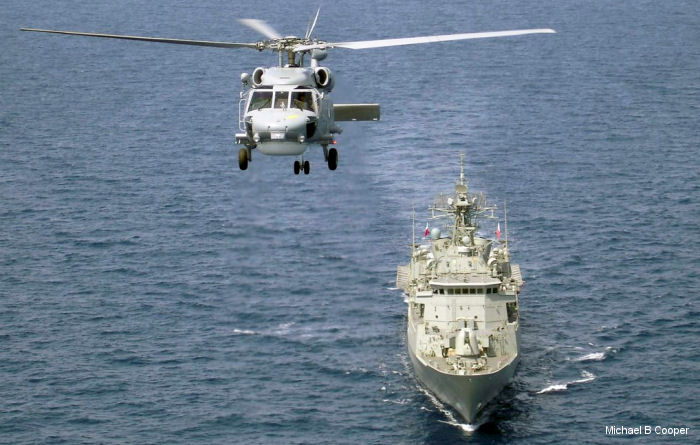
In 2003, Royal Australian Navy ships equipped for helicopter operations included the Adelaide Class frigates (FFG) - HMAS Adelaide (01), HMAS Canberra (02), HMAS Sydney (03), HMAS Darwin (04), HMAS Melbourne (05) and HMAS Newcastle (06); the ANZAC Class frigates (FFH) - HMAS Anzac (150), HMAS Arunta (151), HMAS Warramunga (152), HMAS Stuart (153), HMAS Parramatta (154) and HMAS Ballarat (155); Landing Platform Amphibious (L) vessels - HMAS Kanimbla (51) and HMAS Manoora (52); HMAS Tobruk (50), the replenishment ship (OR) HMAS Success (304), and the Hydrographic Survey ships HMAS Leeuwin (245) and HMAS Melville (246).
In 2017, Australia signed a Joint Statement of Enhanced Strategic Partnership with France.
Units
| Military Forces | |||||
| 723 Squadron | |||||
| 724 Squadron | |||||
| 725 Squadron | |||||
| 805 Squadron | |||||
| 808 Squadron | |||||
| 816 Squadron | |||||
| 817 Squadron | |||||
| 822 Squadron | |||||
Locations
| 2013-2014 |  NAS Jacksonville NAS Jacksonville |
KNIP |
| 1965-1969 |  Sembawang Sembawang |
WSAG |
| 1953- | Nowra | YSNW |
Models
| 2017-2023 | Camcopter S-100 |
| 2015- | EC135T2+ |
| 2013- | MH-60R Seahawk |
| 2012-2019 | 429 |
| 2009-2023 | MRH90 Taipan |
| 2007-2012 | AW109E Power |
| 2003-2008 | Seasprite |
| 1989-2017 | S-70B-2 Seahawk |
| 1984-2017 | AS350 Ecureuil |
| 1975-2011 | Sea King |
| 1973-2000 | ca-32 kiowa |
| 1964-1989 | 204 |
| 1963-1991 | Wessex |
| 1962-1973 | Scout |
| 1953-1966 | Type 171 Sycamore |
Operations
| 01 Jun 20192019 | -- | Australian Bushfires 2019-2020 |
| 14 May 20192019 | 16 May 20192019 | IMDEX Asia 2019 |
| 02 Apr 20192019 | 16 Apr 20192019 |  AUSINDEX 2019 AUSINDEX 2019 |
| 23 Apr 20182018 | 05 May 20182018 |  Exercise Joint Warrior 18-1 Exercise Joint Warrior 18-1 |
| 28 Mar 20172017 | 29 Mar 20172017 | Cyclone Debbie |
| 31 Jan 20172017 | 02 Feb 20172017 |  Exercise Unified Trident Exercise Unified Trident |
| 14 Nov 20162016 | 23 Nov 20162016 |  Kaikoura Earthquake relief operations Kaikoura Earthquake relief operations |
| 12 Sep 20162016 | 24 Sep 20162016 | Exercise Kakadu 16 |
| 12 Apr 20162016 | 16 Apr 20162016 |  Exercise Komodo 2016 Exercise Komodo 2016 |
| 07 Jul 20152015 | 21 Jul 20152015 | Talisman Sabre 2015 |
| 08 Nov 20132013 | -- |  Typhoon Haiyan relief operations Typhoon Haiyan relief operations |
| 03 Oct 20132013 | 11 Oct 20132013 | International Fleet Review Sydney 2013 |
| 15 Jul 20132013 | 06 Aug 20132013 | Talisman Saber 2013 |
| 18 May 20112011 | 20 May 20112011 | IMDEX Asia 2011 |
| 12 Jun 20102010 | 02 Jul 20102010 |  Fleet Review: 100th anniversary of Canadian Navy Fleet Review: 100th anniversary of Canadian Navy |
| 04 Sep 20072007 | 09 Sep 20072007 | Exercise Malabar 07-2 |
| 24 Jun 20052005 | 28 Jun 20052005 | Fleet Review: Trafalgar 200 |
| 29 Jun 20042004 | 28 Jul 20042004 | RIMPAC 04 |
| 05 May 20022002 | -- |  Combined Task Force 150 Combined Task Force 150 |
| 03 Jul 20002000 | 17 Jul 20002000 |  Exercise Flying Fish 2000 Exercise Flying Fish 2000 |
| 02 Sep 19991999 | 28 Feb 20002000 |  INTERFET INTERFET |
| 16 Aug 19901990 | 10 Mar 19911991 |  Operation Desert Shield/Storm Operation Desert Shield/Storm |
| 01 Jan 19901990 | -- | Operation MANITOU |
| 04 Oct 19861986 | 05 Oct 19861986 | Fleet Review: 75th anniversary of RAN |
| 27 Jun 19771977 | 28 Jun 19771977 | Fleet Review: Silver Jubilee of HM The Queen |
| 24 Dec 19741974 | 30 Jan 19751975 | Cyclone Tracy relief operations |
| 20 Sep 19681968 | 13 Oct 19681968 | Exercise Coral Sands |
| 18 May 19671967 | 26 May 19671967 |  Operation Beau Charger Operation Beau Charger |
| 15 Mar 19651965 | 25 Mar 19651965 | Exercise FOTEX 65 |
| 08 Dec 19621962 | 11 Aug 19661966 | Konfrontasi |
| 08 Jun 19531953 | 16 Jun 19531953 | Fleet Review: Coronation Review of the Fleet |
| 03 Oct 19521952 | Operation Hurricane | |