
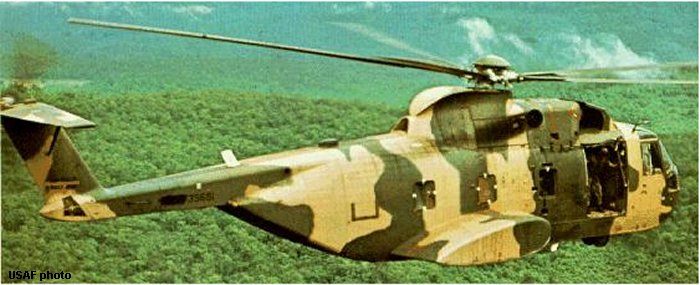
The Sikorsky S-61R, a derivative of the naval SH-3 Sea King,
served with the U.S. Air Force primarily in two roles: the CH-3C/E cargo helicopter and the HH-3E Jolly Green Giant combat search and rescue (CSAR) variant.
These missions were later assumed by the larger Sikorsky S-65, although CH-3 and HH-3 aircraft remained in service into the 1990s.
The main difference from the U.S. Navy variant was that the S-61R incorporated a rear ramp door.
SH-3A -> CH-3A
CH-3B based on S-61R from here
CH-3C
CH-3E, upgrade engine T58-GE-1 to the more powerful T58-GE-5.
HH-3E Jolly Green Giant CSAR
BuNos 62-12571 / 12573 - 3 CH-3A - ex Navy SH-3A (149009,149011,149012)
BuNos 62-12574 / 12576 - 3 CH-3B - the "Otis Falcons"
BuNos 62-12577 / 12582 - 6 CH-3C
BuNos 63-9676 / 9691 - 16 CH-3C
BuNos 64-14221 / 14237 - 17 CH-3C
BuNos 65-5690 / 5700 - 11 CH-3C
BuNos 65-12777 / 12800 - 24 CH-3C, including the famous Black Pony aircraft
BuNos 66-13278 / 13290 - 13 HH-3E
BuNos 66-13291/13296 - 6 CH-3E
BuNos 67-14702 / 14725 - 24 CH-3E
BuNo 68-8282 - 1 HH-3E
BuNos 69-5798 / 5812 - 15 CH-3E
Around 41 of 75 CH-3C were upgraded to CH-3E type
50 CH-3E were upgraded to HH-3E
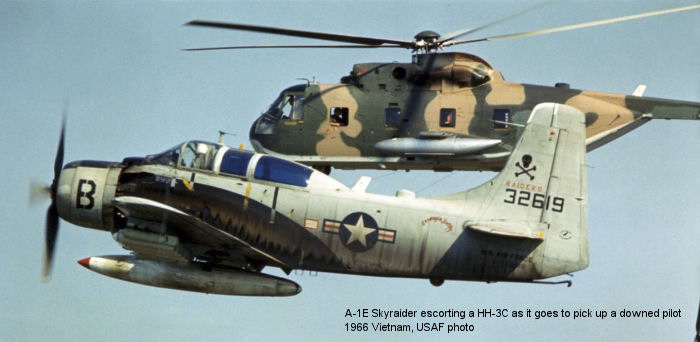
During the Vietnam War, the U.S. Air Force maintained a dedicated search and rescue (SAR) force, initially operating HH-43 Huskie helicopters (call sign Pedro). These were replaced by specially equipped HH-3 Jolly Green Giant helicopters, and later by the HH-53. Rescue missions were typically supported by propeller-driven A-1 Skyraiders (call sign Sandy), selected for their ruggedness, long endurance, heavy payload, and ability to escort and remain with the slower helicopters.
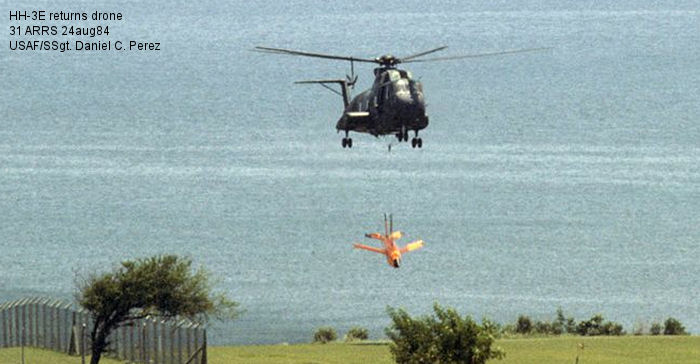
CH-3E helicopters were also configured as MARS birds for the Mid-Air Retrieval System (MARS). Beginning in 1964, reconnaissance and ELINT drone operations in Vietnam were conducted in cooperation with DC-130 Hercules aircraft.
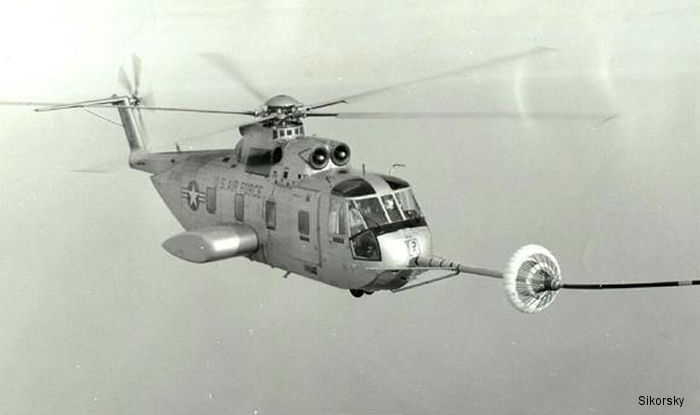
In December 1965, a U.S. Air Force CH-3 performed the first successful helicopter in-flight refueling connection. After the technique was refined, subsequent HH-3Es were built with aerial-refueling probes.
On June 1, 1967, two U.S. Air Force HH-3Es (Sikorsky S-61R) completed the first nonstop transatlantic flight by helicopters, en route to the Paris Air Show. Each aircraft conducted nine aerial refuelings from C-130 Hercules tankers at altitudes between 300 and 2,800 m and at speeds of around 200 km/h. The 6,870 km journey from New York to Paris was flown in 30 hours and 46 minutes.
The HH-3 was withdrawn following Operation Desert Storm in 1991, and the U.S. Air Force officially retired the CH-3 and HH-3 “Jolly Green Giant” fleet by 1995. By then, the type had already been replaced in USAF service by the HH-60G Pave Hawk.
Based on an estimated average airframe life of 8,000 to 12,000 flight hours, the U.S. Air Force H-3 fleet may have accumulated roughly 1.5 million total flight hours over its 30-year service life.
The main difference from the U.S. Navy variant was that the S-61R incorporated a rear ramp door.
SH-3A -> CH-3A
CH-3B based on S-61R from here
CH-3C
CH-3E, upgrade engine T58-GE-1 to the more powerful T58-GE-5.
HH-3E Jolly Green Giant CSAR
BuNos 62-12571 / 12573 - 3 CH-3A - ex Navy SH-3A (149009,149011,149012)
BuNos 62-12574 / 12576 - 3 CH-3B - the "Otis Falcons"
BuNos 62-12577 / 12582 - 6 CH-3C
BuNos 63-9676 / 9691 - 16 CH-3C
BuNos 64-14221 / 14237 - 17 CH-3C
BuNos 65-5690 / 5700 - 11 CH-3C
BuNos 65-12777 / 12800 - 24 CH-3C, including the famous Black Pony aircraft
BuNos 66-13278 / 13290 - 13 HH-3E
BuNos 66-13291/13296 - 6 CH-3E
BuNos 67-14702 / 14725 - 24 CH-3E
BuNo 68-8282 - 1 HH-3E
BuNos 69-5798 / 5812 - 15 CH-3E
Around 41 of 75 CH-3C were upgraded to CH-3E type
50 CH-3E were upgraded to HH-3E
During the Vietnam War, the U.S. Air Force maintained a dedicated search and rescue (SAR) force, initially operating HH-43 Huskie helicopters (call sign Pedro). These were replaced by specially equipped HH-3 Jolly Green Giant helicopters, and later by the HH-53. Rescue missions were typically supported by propeller-driven A-1 Skyraiders (call sign Sandy), selected for their ruggedness, long endurance, heavy payload, and ability to escort and remain with the slower helicopters.
CH-3E helicopters were also configured as MARS birds for the Mid-Air Retrieval System (MARS). Beginning in 1964, reconnaissance and ELINT drone operations in Vietnam were conducted in cooperation with DC-130 Hercules aircraft.
In December 1965, a U.S. Air Force CH-3 performed the first successful helicopter in-flight refueling connection. After the technique was refined, subsequent HH-3Es were built with aerial-refueling probes.
On June 1, 1967, two U.S. Air Force HH-3Es (Sikorsky S-61R) completed the first nonstop transatlantic flight by helicopters, en route to the Paris Air Show. Each aircraft conducted nine aerial refuelings from C-130 Hercules tankers at altitudes between 300 and 2,800 m and at speeds of around 200 km/h. The 6,870 km journey from New York to Paris was flown in 30 hours and 46 minutes.
The HH-3 was withdrawn following Operation Desert Storm in 1991, and the U.S. Air Force officially retired the CH-3 and HH-3 “Jolly Green Giant” fleet by 1995. By then, the type had already been replaced in USAF service by the HH-60G Pave Hawk.
Based on an estimated average airframe life of 8,000 to 12,000 flight hours, the U.S. Air Force H-3 fleet may have accumulated roughly 1.5 million total flight hours over its 30-year service life.
Units

